Career Transition
From Burned Out Chef to €7,000/Month: My First Year as a Private Chef
18 July 2026 · 12 min read
Ready to make the switch? My book covers everything I learned in year one - pricing, finding clients, avoiding mistakes, and building sustainable income.
Buy on Amazon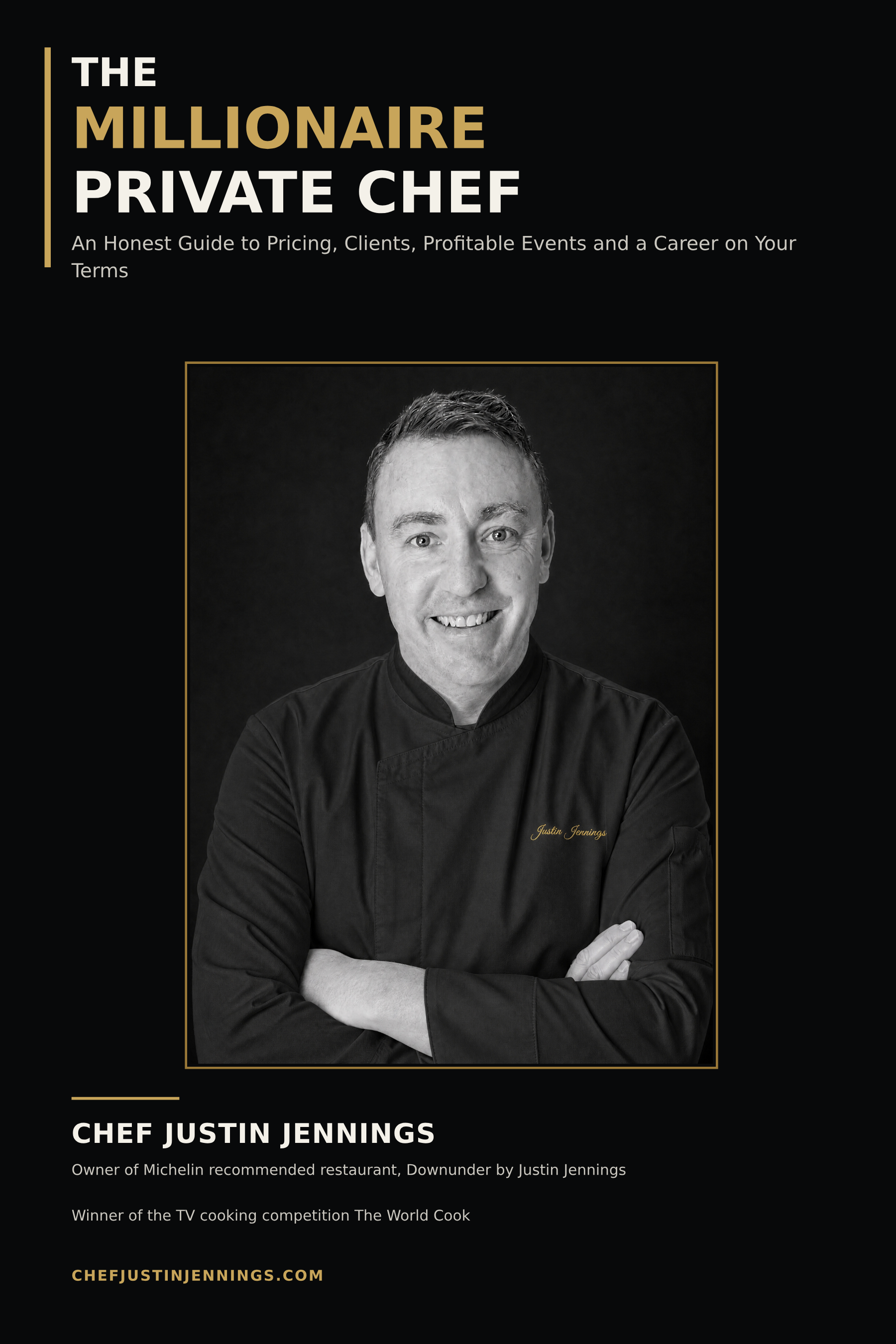
December 2017. I was 32 years old, working 58-hour weeks as a sous chef in a Lisbon restaurant, making €3,200 a month. My knees hurt. My back hurt. I hadn't seen my friends in weeks. I'd missed my nephew's birthday because I couldn't get a Saturday off. And I was tired - the kind of tired that sleep doesn't fix.
I remember standing in the walk-in cooler at 11pm on a Friday, just staring at a tray of prepped mise en place, thinking: "There has to be another way."
There was. One year after I quit that restaurant and went full-time as a private chef, I was making €7,000 a month working 30-hour weeks. I had weekends off (or chose to work them at premium rates). I controlled my schedule. I was cooking food I actually cared about for people who appreciated it.
This is the story of that first year - the good, the bad, and the months where I thought I'd made a huge mistake.
The Breaking Point: Why I Finally Left
I'd been a professional chef for 13 years. Started at 19, worked my way up through Sydney kitchens, spent time in Hong Kong, landed in Lisbon in 2014. By 2017, I was a sous chef at a decent mid-range restaurant. Not fine dining, but solid food, good reviews, steady customers.
On paper, I was doing well. In reality, I was falling apart.
The hours were killing me. My contract said 40 hours a week. I was working 55-60. The extra 15-20 hours? Unpaid. "That's just how it is," the head chef said. And he was right - every restaurant I'd worked in operated the same way.
The money was terrible. €3,200 a month gross. After taxes and rent, I had about €1,400 left for everything else. I was living paycheck to paycheck despite working my ass off 6 days a week.
I had no life. Every weekend gone. Every holiday booked solid. Birthdays, weddings, dinners with friends - I missed them all. My social life consisted of getting drunk with other chefs after service at 1am.
My body was breaking down. Plantar fasciitis in both feet. Chronic lower back pain. A burn scar collection that would impress a self-harmer. At 32, I felt 50.
But here's the thing that finally pushed me over the edge: I wasn't even proud of the food anymore. We ran the same menu for 6 months. Same dishes, same prep, same plating, night after night. I was a robot, not a chef.
The breaking point was watching a 24-year-old commis chef quit after 3 months. Smart kid, good skills, genuinely passionate about food. He looked at me and said: "I can't do this for 10 more years. I'll die."
I realized: that's me in 10 years. If I stay.
The Plan: How I Prepared to Leave
I didn't quit impulsively. I spent 7 months preparing while still working full-time. Here's exactly what I did:
Month 1-2: Research & Reality Check
I spent every spare moment (there weren't many) researching private chef businesses. How much do people charge? How do they find clients? What are the startup costs? I joined online forums, read blogs, watched YouTube videos, and interviewed two local private chefs over coffee.
Reality check: This was going to be hard. Most private chefs take 6-12 months to build consistent income. I needed a financial cushion.
Month 3-5: Save Everything
I cut my expenses to the bone. Moved to a cheaper apartment. Stopped eating out (ironic for a chef). Took on occasional freelance catering gigs on my one day off to build a fund. Goal: save €8,000 to cover 6 months of basic expenses.
This was miserable. I was already exhausted from restaurant work, and now I was working even more. But I knew if I quit without savings, I'd panic when bookings were slow and make stupid decisions (like underpricing or taking terrible clients).
Month 6-7: Build the Foundation
While still employed, I started laying groundwork:
- Registered as a sole trader (about €300 in fees)
- Got liability insurance (€400/year)
- Built a simple website with portfolio photos from restaurant work (€150 for domain + hosting)
- Created Instagram and Facebook pages
- Bought essential equipment: knife kit, portable induction burners, serving platters, containers (€800)
- Told everyone I knew I was going private: friends, family, suppliers, former colleagues
Total startup cost: €1,650. Not huge, but not nothing when you're living on €1,400/month.
Month 7: The Test Event
Before I quit, I needed proof this could work. I offered to cook a private dinner for my girlfriend's boss's 40th birthday party. Eight guests. I charged €600 (€75/person) - way too low, but this was a trial run.
The dinner went well. The food was great. The host was thrilled. But I learned something crucial: this was way more work than I expected. Shopping took 2 hours. Prep at home took 3 hours. Cooking and serving took 4 hours. Cleanup and drive back took 2 hours. That's 11 hours for €600 gross (minus €150 groceries = €450 profit = €40/hour).
Not amazing, but still better than my €14/hour effective wage at the restaurant when you factor in unpaid overtime.
More importantly: I loved it. I controlled the menu. I talked to the guests. I felt like a chef again, not a cog.
I gave my notice the next day.
Thinking about making the leap?
I've documented everything I learned - the good, the bad, the expensive mistakes - in my book. It's the roadmap I wish I'd had.
Month 1-3: The Terror Phase
January 2018. First month as a full-time private chef. I had €8,000 in savings, a website, liability insurance, and exactly zero confirmed bookings.
Month 1 Income: €1,200
Three events total. All came from personal connections - friends of friends, a former restaurant regular, my accountant's sister. I charged €70-€80/person because I was terrified of scaring people away with higher prices.
After groceries, insurance, and transport, I cleared €700. My rent alone was €850.
I was hemorrhaging savings and panicking.
What I did right:
- Got testimonials and photos from every event
- Asked every client for referrals
- Posted everything on Instagram with geotags
- Joined two local Facebook groups (expats in Lisbon, foodies)
What I did wrong:
- Underpriced everything out of fear
- Said yes to a €50/person event that barely broke even
- Didn't have a consistent marketing system - just panicked when calendar was empty
Month 2 Income: €1,800
Five events. Two from referrals, one from Instagram, two from Facebook groups. I raised my prices to €85/person for standard dinners after reading that people equate price with quality.
Cleared €1,100 after costs. Still bleeding savings, but slower.
The best thing that happened: A client booked me for a recurring monthly dinner party. €900/month guaranteed. That single booking reduced my panic level by 50%.
Month 3 Income: €2,400
Seven events. The snowball was starting. Three came from referrals. One was a repeat client. One found me via Google (my website was finally ranking). Two came from a partnership I'd formed with a local event planner.
I cleared €1,600. Still not covering all my expenses, but close. And for the first time since quitting, I felt like this might actually work.
The Event Planner Partnership was a game-changer. I'd reached out to 10 event planners in Lisbon offering a 15% referral commission on any bookings they sent me. Nine ignored me. One said yes. She sent me two high-end clients that month (€1,200 and €1,500 events). I paid her €405 total in commissions and made €1,600 profit. Best €405 I ever spent.
Month 4-6: The Breakthrough
April-June 2018. This is when everything changed.
Month 4 Income: €3,600
I hit my old restaurant salary. Nine events. I was booking 2-3 events per week consistently. Pricing was now €90-€105/person depending on menu complexity.
More importantly: I stopped marketing out of desperation and started marketing strategically. I implemented a system:
- Posted to Instagram 3x per week (food photos, behind-the-scenes, client testimonials)
- Emailed my growing list (now 40 people) once a month with availability
- Reached out to one new venue/event planner/wedding coordinator per week
- Asked every client for a Google review and one referral
This system took maybe 5 hours per week. But it meant I always had leads coming in, even when I was busy cooking.
Month 5 Income: €4,800
Twelve events. I was working harder than I wanted (4-5 events/week = basically full-time), but the money was real.
I also raised my rates to €95-€110/person. Only one person pushed back. Everyone else just said yes.
The big lesson: people weren't price-sensitive in the way I thought. They cared about quality, professionalism, and whether I made them look good in front of their guests. If I delivered that, price was secondary.
Month 6 Income: €5,200
Thirteen events. June is high season in Lisbon (tourists, summer parties, weddings). I could have booked more but deliberately capped it at 3-4 events per week to avoid burnout.
This month I also landed my first "VIP" client - a tech CEO who wanted monthly dinner parties at €2,000 per event (14 guests at €140/person). That single client became 20% of my annual income.
Key realization: One high-paying recurring client is worth 100 one-off low-paying bookings. I started targeting corporate clients, executives, and high-net-worth individuals specifically.
Month 7-9: Scaling & Systemizing
July-September 2018. Summer in Lisbon is insane for private chefs. Tourists, villa rentals, yacht parties, weddings - everyone wants to host.
Average monthly income: €6,200
I was booking 14-16 events per month. Mix of corporate, private parties, and multi-day villa bookings. Pricing was now €100-€130/person standard, €150+ for VIP.
I was making more than double my restaurant salary, working 35-hour weeks instead of 60. On paper, this was the dream.
In reality, I was starting to feel overwhelmed. Not burned out like restaurants, but stretched thin. Shopping, prepping, cooking, driving, invoicing, marketing - it was all on me.
So I started systemizing:
- Created email templates for inquiries, quotes, confirmations, follow-ups
- Built reusable menus by category (casual BBQ, tasting menu, seafood, vegetarian) so I wasn't creating from scratch every time
- Set up recurring grocery delivery from two suppliers
- Hired a part-time admin assistant (€15/hour, 6 hours/week) to handle booking emails, invoicing, and social media scheduling
- Partnered with two other private chefs to share large events (weddings, corporate) instead of turning them down
That €90/week admin assistant was the best hire I ever made. It freed up 6 hours per week that I could spend cooking or resting. And having backup chefs meant I could take vacations without losing income (they'd cover my clients, I'd cover theirs).
Month 10-12: Hitting €7K/Month
October-December 2018. Holiday season. Peak private chef season. Also the time I finally felt like I'd figured it out.
Average monthly income: €7,400
16-18 events per month. I was fully booked most weeks. Pricing was €105-€150/person depending on the event. I'd built enough recurring clients that 40% of my calendar was pre-filled every month.
Month 12 specifically (December): €9,200
Christmas parties, New Year's dinners, corporate events. I worked my ass off, but I chose to. And I charged 20% holiday premiums for December 24-25 and December 31-January 1.
By the end of year one, I'd made €62,000 gross, roughly €42,000 net after all costs. That's about €3,500/month net - basically the same as my old restaurant salary.
Except I was working 30-35 hour weeks instead of 60. I had Sundays off (mostly). I'd taken two actual vacations. My back didn't hurt anymore. I was cooking food I was proud of.
And I knew this was just the beginning. Year two? I'd refine pricing, get better clients, work smarter. The ceiling was way higher than any restaurant could ever pay me.
Want the complete roadmap?
My book includes: pricing worksheets, client acquisition scripts, menu templates, first-year action plan, legal/tax setup guide, and every mistake I made so you don't have to.
What I Learned: The Biggest Lessons From Year One
1. Pricing is 90% of success
If I'd started at €95/person instead of €70, I would have made €15,000 more that year. Underpricing nearly killed my business. Clients don't budget-shop for private chefs - they're hiring you because they want quality and want to impress guests. Price accordingly.
2. Marketing is non-negotiable
You can be the best chef in the world, but if no one knows you exist, you'll starve. Dedicate 5-8 hours per week to marketing even when you're busy. The pipeline needs constant feeding.
3. Recurring clients = financial security
One client booking monthly is worth more than 10 one-offs. Focus on building relationships, not just transactions. Offer retainers, discounts for repeat bookings, and over-deliver on service.
4. Systems save your sanity
Templates, reusable menus, grocery partnerships, admin help - these aren't luxuries, they're survival tools. The faster you systemize, the more you can scale without burning out.
5. You're not just a chef - you're a business owner
Cooking is maybe 60% of the job. Marketing, admin, invoicing, client communication, planning, logistics - that's the other 40%. If you hate business stuff, hire someone or partner with someone who likes it. Otherwise, you'll struggle.
6. The first 90 days are the hardest
Most people who quit private chef work do it in months 2-4 when savings are depleting and bookings are inconsistent. If you can survive those first 90 days, it gets exponentially easier. Have a financial cushion and trust the process.
7. Loneliness is real
Going from a kitchen crew to working solo is jarring. I missed the banter, the team energy, the camaraderie. Combat this by networking with other private chefs, joining food industry groups, and building friendships outside work. Don't isolate.
8. Work-life balance isn't automatic - you have to set boundaries
Just because you can work weekends doesn't mean you should work every weekend. Block off time for yourself. Charge premium rates for holidays. Say no to clients who don't respect your time. Freedom is only valuable if you use it.
9. Quality beats quantity
Better to do 3 amazing events per week at €1,500 each than 7 mediocre events at €700 each. Higher-paying clients tend to be easier, more appreciative, and refer better clients. Chase quality, not volume.
10. This is a real career, not a side hustle
Treat it like one. Invest in equipment, education, insurance, marketing. Show up professionally. Build systems. Plan for growth. The chefs who succeed treat this like a business. The ones who fail treat it like freelance gig work.
The Hard Parts Nobody Talks About
This wasn't all sunshine and €7K months. Here's what sucked about year one:
Income volatility is stressful. Some months I'd book 18 events. Other months, 8. December was €9K. February was €3K. That unpredictability is mentally exhausting, especially when you have bills that don't fluctuate.
Difficult clients exist. The woman who changed the menu 3 times and then complained the food wasn't what she imagined. The guy who tried to negotiate price down after I'd already shopped. The couple who wanted restaurant-quality food but only wanted to pay €50/person. You learn to screen better, but the first year, I took clients I shouldn't have.
You work when others play. Weekends, holidays, summer evenings - these are prime booking times. You can choose not to work them, but then you're leaving money on the table. It's better than mandatory restaurant shifts, but it's still a trade-off.
The admin is endless. Emails, quotes, grocery lists, invoices, taxes, insurance renewals, social media, website updates. If you don't have systems or help, it will drown you.
Imposter syndrome is real. Charging €130/person when I'd been making €14/hour six months earlier felt absurd. I constantly worried clients would realize I wasn't "fancy" enough. Spoiler: they didn't care. They cared that the food was great and I was professional.
Burnout is still possible. It's different from restaurant burnout, but it exists. If you book too many events, don't take breaks, and treat every dinner like a test, you'll burn out. I learned this the hard way in month 8 and had to dial back.
Would I Do It Again?
Absolutely. Without hesitation.
Was it scary? Yes. Did I question the decision multiple times in the first 3 months? Daily. Did I have moments where I thought about going back to restaurants? Twice - both in February when bookings were slow and I was stressed about money.
But five years later, I'm still a private chef. I make over €100K a year now. I work 25-30 hours per week. I travel. I have hobbies. I see my family. I cook food I'm proud of for people who appreciate it.
Every restaurant chef I know is either planning to leave, too burned out to leave, or has already left and regrets not doing it sooner. That's not an exaggeration. The industry is fundamentally broken for anyone who wants a life outside the kitchen.
Private chef work isn't perfect. But it's a hell of a lot better than what most chefs are doing.
If you're reading this from a restaurant kitchen at midnight, exhausted and wondering if there's another way: there is. It's hard, especially the first few months. But it's worth it.
And you're more ready than you think.
Start your own transition
My book includes everything I learned in year one: pricing strategies, client acquisition systems, marketing templates, legal setup, financial planning, and the mistakes that cost me €15,000+ so you can avoid them.
Frequently Asked Questions
How long does it take to replace restaurant income as a private chef?
Most chefs can replace their restaurant income within 3-6 months if they focus on client acquisition and pricing correctly. I hit €3,500/month (my old restaurant salary) within 4 months, and doubled it by month 12. The key is booking 2-3 events per week consistently.
What's the hardest part of the first year as a private chef?
Inconsistent income and client acquisition. The first 90 days are the hardest - you're learning to price correctly, market yourself, and build a client base from scratch. Most chefs who quit do so in months 2-4 when bookings are slow. Having 3-6 months of living expenses saved is crucial.
Do you need savings to start a private chef business?
Yes, ideally 3-6 months of living expenses. It takes time to build consistent bookings, and your first few months will be financially unpredictable. I started with €8,000 saved and lived frugally for 4 months until my income stabilized. You'll also need €1,500-€2,000 for startup costs (insurance, equipment, website, marketing).
Is it lonely working as a private chef after restaurant kitchens?
Yes, initially. You go from a team environment to working solo. Many chefs struggle with this transition. I combated it by joining chef networks, co-working with other private chefs for large events, and attending food industry events monthly. The trade-off is worth it for better work-life balance and income.
Can you go back to restaurant work after being a private chef?
Technically yes, but most don't want to. Once you experience the freedom, higher income, and better lifestyle of private chef work, returning to 60-hour restaurant weeks at lower pay is difficult. Some chefs do both part-time - private events on weekends, consulting or part-time restaurant work during the week.
What mistakes do most new private chefs make in their first year?
The three biggest: 1) Underpricing (charging €50-60/person when they should charge €85+), 2) Not marketing consistently (waiting for clients instead of actively finding them), and 3) Taking every booking (saying yes to low-paying or difficult clients out of desperation). All three lead to burnout and financial struggle.
How many events do you need per week to make €7,000/month?
Roughly 4-5 events per week at €1,200-€1,500 per event. That's €18,000-€24,000 gross per month. After costs (groceries 25%, taxes 30%, insurance, transport), you net €7,000-€8,000. This assumes you're charging €95-€130/person for 8-12 guest dinners.
Do private chefs work weekends and holidays?
Yes, but you choose when. Most private chef events happen Friday-Sunday because that's when clients entertain. Holidays (Christmas, New Year's, birthdays) are peak season and you can charge premium rates. The difference from restaurants: you control your schedule and can block off dates when you want time off.
Ready to Build Your Private Chef Career?
Get the complete roadmap: pricing strategies, client acquisition, marketing systems, legal setup, financial planning, and every lesson from my first year (including the expensive mistakes).
Buy on AmazonIncludes 4 bonus resources: Pricing calculator, contract template, equipment checklist, and 30-day action plan.