Business Models Explained
Private Chef vs Personal Chef: What's the Difference?
19 August 2026 · 9 min read
Want the full breakdown of both business models, pricing strategies, and how to position yourself? Get the complete guide in my book.
Buy on Amazon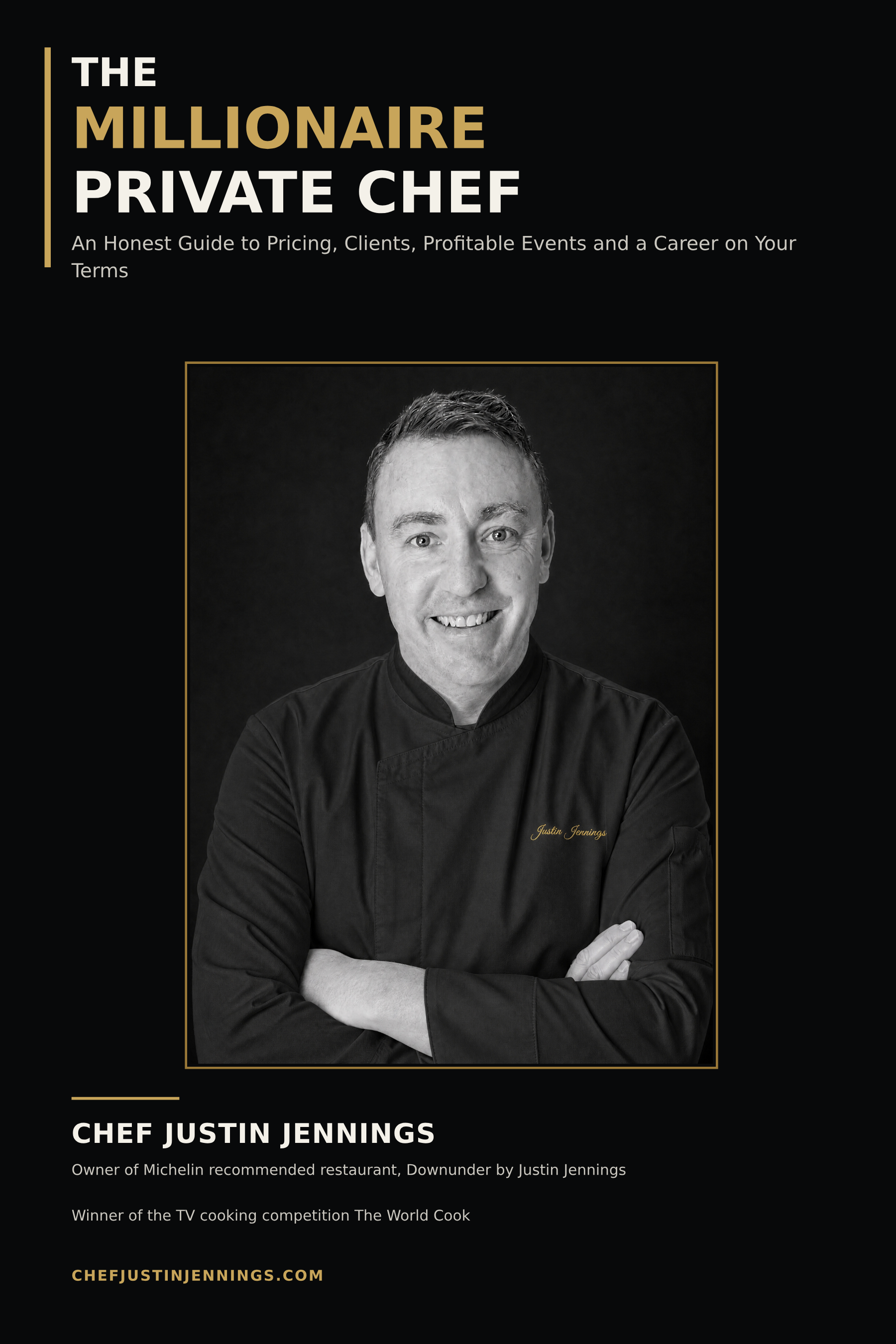
When I tell people I'm a private chef, about half of them ask, "So you live with one family and cook for them every day?"
No. That's not what I do. That's also not what most chefs who call themselves "private chefs" do in 2026.
The confusion is real and it matters. Because if you're starting a chef business outside restaurants, understanding the difference between private chef and personal chef will shape everything: how you price, how you market, and which clients you attract.
Here's the truth: the industry uses these terms inconsistently. Some chefs use them interchangeably. Some define them strictly. Clients? They have no idea what either means they just know they want someone to cook for them.
So let me break it down based on how the terms are actually used in 2026, what clients expect when they search for each, and which model makes more sense for your business.
The Definitions (Industry Standard vs. Reality)
Private Chef (Traditional Definition)
Traditionally, a private chef is employed by one household or individual, often full-time or live-in. Think wealthy families with estates, yachts, or private jets. You're on payroll, you get benefits, and your sole job is cooking for that family.
This is the "Gordon Ramsay cooking for the Beckhams" version. It exists, but it's rare. Maybe 5% of people calling themselves private chefs actually have this arrangement.
Private Chef (How It's Used in 2026)
In practice, private chef now refers to a freelance chef who cooks special events dinner parties, corporate dinners, birthdays, anniversaries, wine tastings. You're hired for one night, you create a custom tasting menu, you plate it beautifully, and you leave.
You're not on anyone's payroll. You have multiple clients. You charge per person or per event. This is what I do, and it's what most people searching "private chef" are looking for.
Personal Chef (Definition)
A personal chef is a freelance chef who provides recurring meal services for multiple clients usually meal prep. You show up to a client's home once or twice per week, cook 4-6 meals, package and label them, and leave. The client heats and eats throughout the week.
You service 3-8 clients per week, each on a set schedule (e.g., Mondays with the Johnsons, Tuesdays with the Smiths). You're paid weekly or monthly, often on retainer.
This model prioritizes convenience and nutrition over special occasion and presentation. Clients are busy professionals, new parents, or health-focused people who want home-cooked meals without the time investment.
Key Differences: Side-by-Side Comparison
| Aspect | Private Chef (Event-Based) | Personal Chef (Recurring) |
|---|---|---|
| Frequency | One-off events or occasional bookings | Weekly or bi-weekly recurring |
| Pay Structure | Per person (€75-150) or per event (€800-3,000) | Hourly (€40-60) or weekly retainer (€500-1,200) |
| Client Type | Hosts, event planners, corporate groups | Busy families, professionals, health-focused individuals |
| Menu Style | Custom tasting menus, fine dining presentation | Batch cooking, meal prep, practical portions |
| Service | Often includes table service, sommelier pairing | Cook, package, label, leave |
| Typical Days | Friday-Sunday evenings | Monday-Thursday daytime |
| Relationship | Transactional, one-off or occasional repeat | Ongoing, trust-based, semi-permanent |
| Marketing Focus | Portfolio, experience, awards, social proof | Convenience, reliability, dietary expertise |
Which Is More Profitable?
This is the first question every chef asks and the answer is: it depends on your pricing and volume.
Private Chef (Event-Based) Math
Let's say you charge €95 per person for a tasting menu dinner. Average event is 8 people = €760. You spend 6 hours total (shopping, prep, cooking, service, cleanup). That's €127/hour.
Do 8 events per month (2 per week). That's €6,080/month working 48 hours roughly 12 days of actual work. Annual: €72,960.
Scale to 12 events/month, and you're at €109,440/year working 18 days per month.
Personal Chef (Recurring) Math
Let's say you charge €50/hour and spend 4 hours per client session (cooking 5 meals). That's €200 per client visit.
If you see each client once per week, that's €800/month per client. Service 5 clients, and you're at €4,000/month = €48,000/year.
But you're working 20 hours per week consistently (80 hours/month), plus shopping time.
To match the private chef income (€72,960), you'd need 7-8 weekly clients or raise your rates to €60-70/hour.
The Real Difference
Private chef work (event-based) has higher per-hour earnings but is less predictable. Some months you're slammed; others are slow. Your income fluctuates with event demand (weddings in summer, corporate in December, slow in January).
Personal chef work (recurring) has lower hourly rates but steadier income. You know exactly what's coming in every month. Clients stay for 6-18 months on average, so once you fill your roster, you have predictable cash flow.
My model? Hybrid. I do 60% private chef events (higher margins, flexible schedule) and 40% personal chef retainers (base income, predictable cash flow). This balances feast-or-famine risk while maximizing earnings.
Which Is Better for Lifestyle?
This matters more than money for most chefs leaving restaurant burnout.
Private Chef (Event-Based) Lifestyle
- Pros: Total calendar control (say no to any date), weekdays free, creative freedom, variety of events and menus
- Cons: Income variability, evenings/weekends booked, last-minute cancellations, occasional feast-or-famine stress
If you value flexibility and autonomy, this is the better model. You can take a week off whenever you want just don't book events that week. No one to answer to.
Personal Chef (Recurring) Lifestyle
- Pros: Predictable schedule, weekends free (most personal chef work is Mon-Thu), consistent income, less sales/marketing needed
- Cons: Routine can feel repetitive, harder to take time off (clients depend on you), less creative variety
If you value routine and predictability, personal chef work fits better. You know your schedule weeks in advance. Clients expect you every Monday at 9am. It's structured, consistent, and you're home by dinner.
What Clients Actually Search For
Here's the thing: clients don't care about terminology. They search for what they need, not industry definitions.
When someone Googles "private chef," they're usually looking for:
- Someone to cook a special dinner party
- A chef for a birthday or anniversary
- Catering for a corporate event
- Tasting menu experience at home
When someone Googles "personal chef," they're usually looking for:
- Weekly meal prep service
- Someone to cook healthy meals regularly
- A chef for ongoing family dinners
- Custom nutrition-focused meal plans
Your job: make it obvious what you offer.
Don't make clients decode jargon. On your website, Instagram, or wherever you market, describe your services in plain language:
- "I cook elegant tasting menu dinners for special occasions at your home."
- "I prepare a week's worth of healthy, delicious meals every Monday morning."
Use both terms if you offer both services but make it crystal clear what each means.
Can You Do Both? (Yes. Here's How.)
Most successful independent chefs operate hybrid models. I do. Here's why it works:
- Recurring personal chef clients provide base income. Two weekly clients at €800/month each = €1,600 guaranteed income before you book a single event.
- Private chef events provide high-margin upsells. You can charge €95-150/person for events vs €50-60/hour for meal prep.
- You balance routine with creativity. Meal prep clients keep you grounded; special events keep you inspired.
- You smooth out income fluctuations. Slow event months? Your retainer clients carry you. Busy event season? Scale back meal prep temporarily.
How to Structure a Hybrid Model
Option 1: Weighted Toward Events (My Model)
- 2-3 recurring personal chef clients (Mon-Wed mornings)
- 8-12 private chef events per month (Thu-Sun)
- Fridays and Saturdays reserved for high-margin events
Option 2: Weighted Toward Recurring Income
- 5-7 weekly personal chef clients (Mon-Thu)
- 2-4 private chef events per month (weekends only)
- Prioritize stability over flexibility
The key: schedule personal chef clients on weekdays so your prime event nights (Fridays and Saturdays) stay open for higher-paying bookings.
Ready to Build Your Chef Business?
Learn both business models in depth, including pricing calculators, client contracts, marketing templates, and the exact systems I use to run a 6-figure chef business.
How to Position Yourself (Marketing & Branding)
The terminology you use matters for SEO and client perception. Here's how to position yourself based on what you actually do.
If You Do Event-Based Work (Private Chef)
Call yourself a "Private Chef" on:
- Instagram bio: "[Your Name] | Private Chef | [City]"
- Website title tag: "Private Chef [City] | Tasting Menu Dinners & Events"
- Google My Business: "Private Chef Services"
Emphasize: Experience, credentials (MICHELIN, TV, awards), portfolio of plated dishes, testimonials from event hosts, special occasion focus
Keywords to target: "private chef [city]", "hire private chef", "private chef for dinner party", "in-home tasting menu"
If You Do Recurring Meal Prep (Personal Chef)
Call yourself a "Personal Chef" on:
- Instagram bio: "[Your Name] | Personal Chef | Weekly Meal Prep [City]"
- Website title tag: "Personal Chef [City] | Healthy Meal Prep Services"
- Google My Business: "Personal Chef & Meal Prep"
Emphasize: Convenience, reliability, dietary expertise (keto, vegan, gluten-free), time savings, family-friendly, health benefits
Keywords to target: "personal chef [city]", "meal prep chef", "weekly meal service", "hire chef for meal prep"
If You Do Both (Hybrid Model)
Use "Private Chef" as your primary title (it sounds more premium and gets more search volume), but describe both services clearly on your website:
"I'm a private chef based in Lisbon offering two services: Special Event Dinners (tasting menus for dinner parties, birthdays, corporate events) and Weekly Meal Prep (personalized meal plans delivered to your home). Both services bring restaurant-quality cooking to your kitchen."
This way, you rank for both search terms and let clients self-select based on their needs.
Common Misconceptions (Let's Clear Them Up)
Misconception 1: "Private chefs are only for billionaires."
Reality: My average client is a two-income professional couple earning €80,000-150,000 combined. They book me 1-2 times per year for birthdays or anniversaries. I also work with middle-class families who hire a personal chef once a month to free up weekends. It's not exclusively ultra-wealthy it's people who value time and experience over cooking themselves.
Misconception 2: "Personal chefs live with their clients."
Reality: No. That's a 1950s model. Modern personal chefs are independent contractors who show up, cook, and leave. You maintain your own home and service multiple clients. Live-in positions exist (usually called "household chefs" or "estate chefs"), but they're rare and typically involve ultra-high-net-worth families or yacht crew.
Misconception 3: "You need a culinary degree to call yourself a private chef."
Reality: Clients care about experience, taste, and presentation not credentials. I know private chefs earning €120,000/year who never went to culinary school. What matters: strong portfolio, good testimonials, food safety certification, liability insurance. Formal training helps, but it's not a barrier to entry.
Misconception 4: "Personal chef work is less prestigious than private chef events."
Reality: It's just different. Personal chefs build long-term relationships and solve real problems (health, convenience, family time). Private chefs create memorable experiences and showcase culinary artistry. Both require skill. Both can be highly profitable. One isn't "better" they serve different markets.
Which Should You Start With?
If you're launching your chef business and unsure which model to pursue, here's my advice:
Start with private chef events (event-based).
Here's why:
- Lower commitment for clients. It's easier to convince someone to hire you for one dinner party than commit to weekly meal prep.
- You can test pricing without long-term risk. If your first event doesn't go well, you learn and adjust. No ongoing obligation.
- Faster portfolio growth. Each event gives you new dishes to photograph, testimonials to collect, and experience across diverse menus.
- You can do it alongside a restaurant job. Book events on your days off while you build clientele.
- Higher perceived value. Event-based work positions you as a premium service, which makes it easier to charge premium rates.
Then, once you have 10-15 successful events:
- Reach out to past clients: "I now offer weekly meal prep for busy families. Would this interest you?"
- Offer a trial: "Try 4 weeks at a discounted rate."
- Add 1-2 personal chef retainer clients for base income.
This progression events first, recurring clients second lets you build trust, test the market, and grow income predictably.
Final Thoughts: The Labels Don't Matter. The Service Does.
Private chef. Personal chef. Freelance chef. Independent chef. Event chef. Meal prep chef.
The industry will keep debating definitions. Clients will keep using the terms interchangeably. And that's fine.
What matters is this: Can you cook great food? Can you serve clients well? Can you run a sustainable business?
If yes, the label you choose is just marketing. Pick the one that matches your service model, make it clear what you offer, and get to work.
I call myself a private chef because 70% of my income comes from events. But I do personal chef work too. And I don't lose sleep over whether I'm using the "correct" terminology.
Neither should you.
Figure out which clients you want to serve, what cooking you enjoy most, and what lifestyle you're building. Then structure your business around that whether it's event-based, recurring, or hybrid.
The freedom to choose? That's the whole point of leaving restaurants.
Learn Both Business Models in Depth
My book The Millionaire Private Chef covers both event-based and recurring models, including pricing strategies, client contracts, marketing systems, legal setup, and how to structure a hybrid business that maximizes income and flexibility.
Written by someone who actually runs this business not a theorist. Real numbers, real templates, real strategies.
Buy on AmazonFrequently Asked Questions
Which pays more: private chef or personal chef?
Private chefs working event-based typically earn more per hour (€75-150/person for events vs €40-60/hour for meal prep), but personal chefs with multiple weekly clients can earn more annually through consistent income. A private chef doing 8 events per month at €1,200 each earns €115,200/year working 16-20 days. A personal chef with 5 clients at €800/week earns €208,000/year but works 5 days per week. The private chef model offers higher per-hour rates; the personal chef model offers steadier cash flow.
Can you be both a private chef and personal chef?
Yes, many chefs operate hybrid models. I do 60% private chef events (dinners, parties) and 40% ongoing personal chef work (weekly/monthly clients). This gives you the best of both worlds: high-margin event work plus predictable recurring income. The key is managing your calendar so weekly meal prep clients don't block out prime event dates (Fridays and Saturdays). Hybrid models are especially smart when you're building your business personal chef retainers provide base income while you grow your event portfolio.
What do clients prefer: private chef or personal chef?
It depends on the client's need. Busy professionals and families with young children prefer personal chefs for weekly meal prep and routine cooking. People hosting special events birthdays, anniversaries, corporate dinners prefer private chefs for one-off experiences. Wealthy individuals may hire both: a personal chef for daily meals and a private chef for entertaining guests. When marketing, clarify which services you offer. Most clients don't know the terminology they just know they want 'someone to cook for them'.
Which is easier to start: private chef or personal chef?
Private chef work (event-based) is easier to start because you can take bookings around an existing job, test pricing with one-off events, and require less weekly commitment from clients. Personal chef work requires building trust for ongoing access to someone's home and kitchen, plus clients want consistency (same day/time weekly). Most chefs start with private chef events to build a portfolio and testimonials, then add personal chef retainer clients once they have social proof and demand. Start event-based, add recurring clients later.
Are there legal differences between private chef and personal chef?
Legally, both are typically classified as self-employed sole traders or freelancers the distinction is more about service model than legal structure. However, insurance needs may differ: personal chefs working in client homes weekly need robust liability coverage, while private chefs doing events may need additional event insurance. Food safety certifications, business licenses, and tax obligations are the same regardless of terminology. Always register as self-employed, get liability insurance, and maintain food handler certification no matter which model you choose.
Do private chefs pay more in taxes than personal chefs?
No, tax obligations are identical both are self-employed and taxed on net profit. The real difference is cash flow: personal chefs with weekly retainers receive consistent income, making quarterly tax payments easier to plan. Private chefs with event-based income may have feast-or-famine months, requiring more disciplined saving for tax obligations. Set aside 30% of every payment for taxes regardless of model. Deductible expenses (equipment, ingredients, transport, insurance) are the same for both. Consult an accountant familiar with food service businesses.
Which has better work-life balance: private chef or personal chef?
Private chefs (event-based) typically have better work-life balance because you control your calendar and can decline bookings. Work 2-3 events per week, take weekdays off, and say no to dates that don't work. Personal chefs commit to weekly schedules for multiple clients, which creates routine but less flexibility you can't easily cancel recurring appointments. However, personal chef work rarely involves evenings or weekends (meal prep is typically Monday-Thursday), while private chef events are often Friday-Sunday. Choose based on your lifestyle: prefer routine predictability or flexible scheduling?
How do you position yourself as a private chef vs personal chef?
Use the terminology your target clients search for. If you do event-based work (dinner parties, corporate events, celebrations), call yourself a 'Private Chef' and emphasize experience, plating, special occasions. If you do weekly meal prep and routine cooking, call yourself a 'Personal Chef' and emphasize convenience, nutrition, family meals. Many chefs use both terms on their website with separate service descriptions. Most clients don't understand the difference, so describe the service clearly: 'I cook tasting menu dinners for special events' or 'I prepare a week's worth of healthy meals every Monday'.
Do personal chefs live with their clients?
No, modern personal chefs do not live with clients. That's an outdated model associated with live-in household staff. Today's personal chefs arrive at clients' homes on scheduled days (e.g., Monday mornings), cook 4-6 meals, package and label them, clean up, and leave. You maintain your own residence and typically service 3-8 clients per week. Live-in positions still exist for ultra-high-net-worth families or yacht crew, but they're rare and called 'household chefs' or 'estate chefs'. The term 'personal chef' in 2026 refers to a freelance professional providing recurring meal services.
Which model is better for a new private chef business?
Start with private chef events (one-off bookings) for three reasons: you can test the market without long-term commitments, clients are easier to find (everyone hosts events occasionally), and you build a portfolio of diverse work faster. Once you have 10-15 successful events and strong testimonials, offer personal chef services to past clients: 'I now offer weekly meal prep for busy families. Interested?' Converting event clients into retainer clients is the easiest sales path. A hybrid model is ideal: base income from 2-3 weekly personal chef clients, plus higher-margin private events on weekends.
Related Articles
Pricing Strategy
How to Price Your First Private Chef Event
Learn my pricing framework so you don't undercharge (or lose clients by pricing too high).
Client Acquisition
Getting Your First Private Chef Client: 5 Proven Methods
Five strategies that work better than anything else to land your first paying clients.
Complete Guide
How to Start a Private Chef Business in 2026
The complete step-by-step startup guide from someone who's been there.