Client Acquisition System
Getting Your First 10 Private Chef Clients: Proven 90-Day System
31 July 2026 · 16 min read
Get the complete client acquisition roadmap with templates, scripts, and week-by-week action plans. My book includes outreach email templates, referral systems, and pricing scripts that booked my first 15 clients in 8 weeks.
Buy on Amazon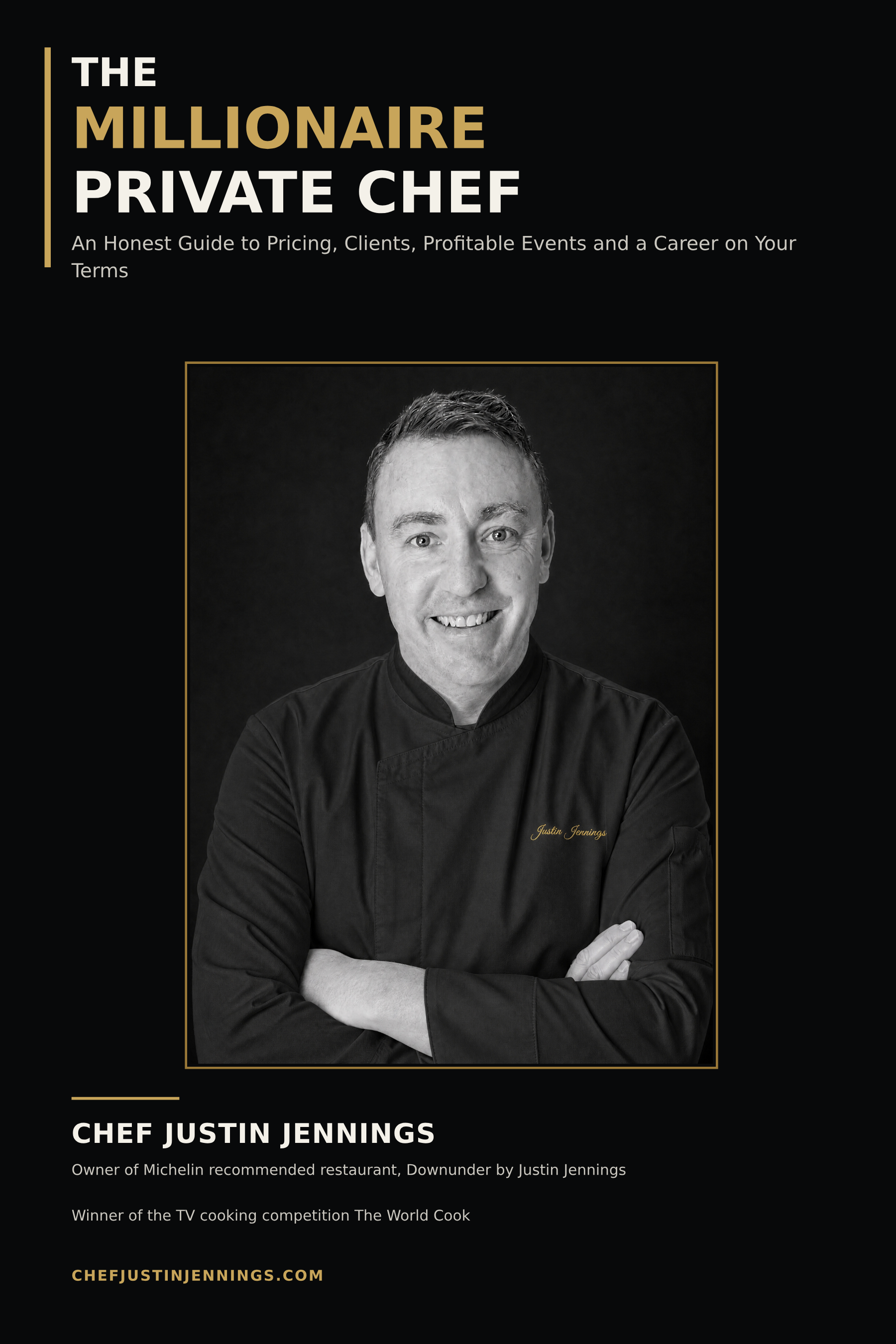
The hardest part of starting as a private chef isn't the cooking. It's getting people to trust you enough to let you into their home and pay you hundreds of euros for a meal.
When I left my restaurant job in 2021, I had 15 years of professional cooking experience, a solid reputation in Lisbon's food scene, and exactly zero private chef clients. I knew I could cook. I just had no idea how to convince strangers to hire me.
So I did what any desperate chef does: I asked everyone I knew, posted everywhere I could, and treated client acquisition like a second full-time job. Sixty-seven days later, I'd booked my tenth paying client. Three months after that, I was fully booked with a waitlist.
Here's exactly how I did it and how you can replicate the system to land your first 10 clients in 90 days or less.
Why the First 10 Clients Matter More Than Anything Else
Most private chefs quit before they reach 10 clients. They book one or two events, run out of leads, panic about money, and go back to restaurant work.
But if you can push through to 10 clients, everything changes:
- You've proven the model works 10 paying clients means your service, pricing, and marketing are viable
- Referrals start flowing each of those 10 clients refers 1-2 more on average (that's 10-20 new leads without spending a euro)
- You've built real social proof 10 testimonials and 50+ photos make your portfolio look legitimate to new prospects
- Confidence kicks in you've done this enough times to know you can handle any client or event
- Cash flow stabilizes 10 clients at €750 average per event = €7,500 in revenue, enough to cover costs and reinvest in growth
The first 10 clients are your foundation. After that, momentum takes over and the business runs itself. But you have to survive long enough to get there.
The 90-Day Timeline: What to Expect
Here's the realistic timeline for landing 10 clients if you're hustling hard:
Days 1-7: Launch Preparation
Get insurance, build basic website/Instagram, create sample menus, take photos of 5-10 dishes, set pricing, draft outreach messages.
Days 8-30: Warm Network Blitz (Clients 1-3)
Message 50-100 friends/family/colleagues. Post on social media daily. Book your first 1-3 events from people who already trust you. Goal: €2,000-€3,000 revenue.
Days 31-60: Referrals + Local Networking (Clients 4-7)
Ask first clients for referrals. Join local Facebook groups. Partner with event planners. Start cold outreach to high-value prospects. Goal: 3-4 more bookings, €3,000-€4,000 revenue.
Days 61-90: Scaling Systems (Clients 8-10+)
Launch paid ads (Instagram/Facebook). Optimize website for SEO. Build email list. Leverage testimonials. Goal: 3+ bookings, €3,000+ revenue, plus pipeline for months 4-6.
This timeline assumes you're treating client acquisition like a full-time job: 3-4 hours per day on marketing, outreach, and follow-up. If you're doing this part-time while still working a restaurant job, stretch it to 120-150 days.
Want the Complete Week-by-Week Roadmap?
My book includes a detailed 90-day action plan with daily tasks, outreach templates, referral scripts, and marketing calendars. Skip the guesswork and follow the exact system I used to book 15 clients in 8 weeks.
Buy on AmazonMethod 1: Warm Network Outreach (Clients 1-3)
Your first clients will come from people who already know and trust you. This is non-negotiable. Don't try to book strangers first start with your existing network.
Who to contact:
- Friends and family (obvious, but most chefs skip this out of embarrassment)
- Former restaurant colleagues and hospitality contacts
- Neighbors and local community members
- Social media followers who engage with your posts
- Anyone you've cooked for informally (dinner parties, potlucks, BBQs)
The outreach message (adapt to your voice):
"Hey [Name], I'm launching a private chef service in [City] and offering custom dinner parties in people's homes. I'd love to cook for you and a few friends think 4-course menu, all shopping/cooking/cleanup handled, no stress for you. I'm offering a launch special (30% off) for my first 10 events to build my portfolio. Interested? Would love to create something amazing for you."
Why this works:
- It's personal and specific, not a generic sales pitch
- The discount is framed as a launch opportunity, not a desperate plea
- You're offering to solve a problem (hosting stress) rather than just selling a service
- Low commitment they can say no without feeling awkward
Volume matters: Message 50-100 people in week 1. Expect a 20-30% response rate and a 5-10% booking rate. That's 5-10 bookings from 100 messages. Don't cherry-pick go wide. You'll be surprised who books.
Social media amplification: Post about your launch 3-5 times in the first two weeks. Use variations like:
- "I'm officially launching as a private chef. First 10 bookings get 30% off. DM me if you want a custom menu."
- "Why go to a restaurant when I can bring the restaurant to your home? Private chef services now available in [City]."
- Behind-the-scenes content: "Prepping for my first private dinner party this weekend. Menu: [dishes]. Can't wait."
Tag people. Use local hashtags (#LisbonFoodie, #LisbonChef, etc.). Make it easy for people to share.
Method 2: Referral Machine (Clients 4-7)
Once you've completed your first 2-3 events, it's time to turn those clients into your sales team. Referrals are the fastest, cheapest, and most effective way to book your next clients.
The ask (immediately after the event):
"I'm so glad you enjoyed tonight! I'm building my private chef business and would love your help. Do you know 1-2 people who might enjoy a custom dinner party like this? I'd love to cook for them. Happy to offer them the same launch rate you got."
Why this timing works: People are most enthusiastic about your service in the 30 minutes after you've finished. They're relaxed, full, happy, and surrounded by impressed guests. That's your referral window. Don't wait until later ask right then.
Make it easy for them:
- Create a simple referral PDF or image they can forward (your menu, pricing, contact info)
- Offer a referral incentive: "Book someone and get 15% off your next event"
- Follow up 3-5 days later: "Hey [Name], thanks again for Saturday. Did you get a chance to think of anyone who might want a private chef dinner?"
Leverage guest lists: At every event, you're cooking for 6-12 people. That's 6-12 potential clients. Chat with guests during service, hand out business cards, and mention you're taking bookings. At least one person per event will inquire that's 10% of your future bookings right there.
Track referrals: Keep a simple spreadsheet: Client Name | Event Date | Referrals Given | Bookings Closed. This shows you who your best advocates are (send them thank-you gifts) and helps you improve your referral ask.
Method 3: Local Partnerships (Clients 5-8)
You don't need to convince everyone in your city to hire you you just need to partner with the people who already have access to your ideal clients.
Who to partner with:
- Wedding and event planners they're constantly asked "Do you know a good caterer or private chef?" Offer them 10-15% commission for referrals
- Luxury concierge services high-net-worth individuals use concierges to book everything from travel to private chefs
- Airbnb Superhosts and villa rental managers guests staying in luxury rentals often want private chef experiences
- Personal trainers and nutritionists they work with clients who need custom meal prep and healthy dining options
- Yacht and boat charter companies marine charters need onboard private chefs for multi-day trips
The partnership pitch:
"Hi [Name], I'm a private chef in [City] specializing in [cuisine/niche]. I know your clients sometimes need custom dining experiences. I'd love to partner with you I offer 15% commission for every booking you send my way, and I'll make your clients look like heroes for recommending me. Can I send you my menu and pricing?"
Make it a no-brainer: Partners will only refer you if it's easy and makes them look good. Provide them with:
- A one-page PDF with your services, sample menus, and pricing
- High-quality photos they can show potential clients
- A simple referral tracking system (they text you the client's name, you handle the rest)
- Fast response times reply within 2 hours to any referral inquiry
Where to find partners: Search "[Your City] event planner," "[Your City] concierge," "[Your City] Airbnb management" on Google and Instagram. Message 5-10 per week. Even one good partnership can feed you 2-4 clients per month.
Method 4: Direct Outreach to High-Value Prospects (Clients 6-10)
This is the method most chefs avoid because it feels pushy. But it's also the fastest way to book high-paying clients once you have social proof from your first few events.
Who to target:
- People posting about upcoming birthdays, anniversaries, or celebrations on social media
- Local business owners and entrepreneurs (check LinkedIn)
- People who recently moved to your city (search moving hashtags, local Facebook groups)
- Corporate HR and admin teams planning company events
- Luxury real estate agents hosting client appreciation events
The cold outreach message (Instagram DM or email):
"Hi [Name], I saw you're planning [event/celebration] and wanted to reach out. I'm a private chef in [City] specializing in [cuisine]. I create custom dinner parties handle all the shopping, cooking, plating, and cleanup so you can actually enjoy your event. Here's a recent menu I did for a client: [3-4 dishes]. Would you be interested in a quick call to discuss your event? No pressure if it's not a fit."
Why this works:
- It's personalized you reference their specific situation
- You lead with value (taking stress off their plate) rather than pushing a sale
- Sample menus create instant desire and show you're legit
- The "no pressure" line makes it feel safe to respond
Volume is key: Send 10 messages per day, 5 days per week. That's 200 messages per month. With a 10-15% response rate and 30-40% booking rate from responses, you'll close 6-12 clients per month once you dial in your messaging.
Follow up relentlessly: Most people won't respond to the first message. Send a follow-up 3-5 days later:
"Hey [Name], just wanted to follow up on my last message about your [event]. I have a couple of dates opening up in [month] if you'd like to lock something in. Let me know!"
Response rates jump 40-50% with one follow-up. Don't be afraid to persist you're offering a valuable service, not selling junk.
Method 5: Social Media Content Machine (Ongoing Lead Flow)
Social media won't book your first client, but it creates a steady flow of inbound inquiries once you have momentum. Post consistently from day one so it starts working by month 2-3.
What to post (daily rotation):
- Monday: Behind-the-scenes prep (knife skills, ingredient selection, technique)
- Tuesday: Finished dish photos (your best plating work)
- Wednesday: Client testimonial or review (screenshot or video)
- Thursday: Menu spotlight (share a recent menu with descriptions and wine pairings)
- Friday: Availability post ("Taking bookings for October 2 spots left this month")
- Saturday: Event recap (photo carousel from recent dinner party)
- Sunday: Educational content (cooking tips, ingredient guides, recipe ideas)
Platform strategy:
- Instagram: Primary platform for private chefs. Use Reels (short videos) for reach, Stories for engagement, Feed posts for portfolio
- Facebook: Join 5-10 local food and community groups. Post your services weekly (follow group rules don't spam)
- TikTok: Optional but powerful for younger demographics. Short cooking videos, "day in the life" content, and client reactions
- LinkedIn: Underrated for corporate and high-net-worth clients. Post about private chef services for business dinners and executive entertaining
Hashtag strategy: Mix of local, service, and niche hashtags:
- Local: #LisbonChef #LisbonFoodie #LisbonEats
- Service: #PrivateChef #PersonalChef #InHomeDining #PrivateDining
- Niche: #AustralianCuisine #AsianFusion #FineDiningAtHome
Use 15-20 hashtags per post. Rotate them to avoid Instagram shadowbanning.
Engagement is crucial: Reply to every comment and DM within 2 hours. Like and comment on 20-30 local food posts per day. Follow potential clients and partners. Social media rewards active participation, not passive posting.
Ready to Book Your First 10 Clients?
Stop guessing and start booking. My book gives you the complete system: outreach templates, referral scripts, partnership pitch decks, social media content calendars, and week-by-week action plans. Everything I used to go from zero to fully booked in 90 days.
Buy on AmazonInstant access. Start booking clients this week.
Common Mistakes That Kill Momentum
Most chefs who fail to reach 10 clients make one (or more) of these mistakes:
Waiting to be "ready" before launching
You don't need a perfect website, professional branding, or 50 menu options. You need one client. Launch with a basic Instagram profile, 2-3 sample menus, and clear pricing. Improve as you go. Every week you wait is a week you're not booking clients or collecting testimonials.
Underpricing to seem accessible
Charging €40-50 per person "to get experience" attracts nightmare clients who haggle, demand free extras, and never rebook. Price at €75-95 per person from day one. Quality clients expect to pay quality prices. Confidence in your pricing attracts better clients and more bookings.
Relying only on social media
Instagram won't book your first 5 clients. It's too slow and passive. You need active outreach: messaging people, asking for referrals, networking locally, and doing direct sales. Social media is support, not your primary strategy. Treat it as a portfolio, not a booking engine.
Not asking for referrals after great events
Every happy client knows 2-3 people who would also hire you. But they won't refer you unless you ask. Make the referral ask part of your post-event routine. "Do you know anyone who'd enjoy a dinner like this?" Simple question, massive impact. Referrals are 5X easier to close than cold leads.
Inconsistent follow-up
Most bookings happen on the second or third touchpoint, not the first. If someone inquires but doesn't book immediately, follow up 3 days later, then 7 days later, then 2 weeks later. Be persistent without being annoying. You're reminding them, not harassing them. Half your bookings will come from follow-ups.
Giving up too early
The first 30 days are brutal. You'll message 100 people and book 2 clients. You'll post every day and get crickets. You'll question whether this was a mistake. Push through. Month 2 is easier. Month 3 is exponentially better. Momentum is real, but you have to survive long enough to feel it.
Tracking Your Progress: The 10-Client Scorecard
Create a simple spreadsheet to track your client acquisition efforts. This keeps you accountable and shows what's working:
| Week | Outreach Sent | Responses | Bookings | Revenue |
|---|---|---|---|---|
| Week 1 | 50 messages | 12 | 1 | €630 |
| Week 2 | 30 messages | 8 | 1 | €760 |
| Week 3 | 40 messages | 15 | 2 | €1,520 |
| Week 4 | 25 messages | 10 | 1 | €840 |
Track source of each booking (warm network, referral, social media, cold outreach, partnership). This tells you where to focus your energy. If 70% of bookings come from referrals, double down on asking for referrals. If cold outreach isn't working, pivot to partnerships.
Key metrics to watch:
- Response rate: Should improve from 10% in week 1 to 25-30% by week 8 as your messaging improves
- Booking conversion rate: Target 40-50% of people who respond should book (if lower, your pricing or service description needs work)
- Average event size: Track guests per event larger events = more referrals and better revenue per booking
- Time to booking: How many days from inquiry to booking? Goal is under 7 days (faster = less chance they book someone else)
What Happens After Client #10?
Once you've booked your tenth client, you've officially crossed the threshold from "trying to make this work" to "running a real business." Here's what changes:
Referrals become your primary lead source. By now, you have 10 happy clients who each know 50-100 people. If you've asked for referrals consistently, you'll have a pipeline of 5-10 warm leads who were referred by someone who trusts you. These close at 60-70% compared to 30-40% for cold leads.
Your social proof is bulletproof. Ten testimonials, 50+ event photos, and a portfolio of diverse menus make you look established. New prospects stop asking "Are you legit?" and start asking "When are you available?"
Pricing pressure disappears. You've proven people will pay your rates. Stop offering discounts. Raise prices 10-15% for new clients. Quality clients don't haggle they book or they don't. The ones who complain about price weren't going to be good clients anyway.
Systems and templates save you hours. By client #10, you've sent the same booking confirmation, menu planning questionnaire, and post-event follow-up dozens of times. Template everything. Build a simple CRM (even a Google Sheet works). Automate reminders. Free up mental energy for cooking and client relationships.
You start saying no to bad-fit clients. Not every inquiry is worth pursuing. Low-budget clients, overly demanding personalities, unclear expectations you can afford to be selective now. Your time is valuable. Protect it.
Final Thoughts: Speed Beats Perfection
The chefs who reach 10 clients in 90 days aren't the ones with the best websites, fanciest branding, or most followers. They're the ones who hustle relentlessly, ask for business without apology, and refuse to quit after a bad week.
Your first 10 clients won't be perfect. Some will book at a discount. Some will be friends doing you a favor. Some will have unrealistic expectations. That's fine. You're not building a perfect business in 90 days you're proving the model works and building momentum.
Every event you cook is a chance to improve your systems, refine your service, and collect social proof. Every client is a potential referral source. Every booking brings you closer to the tipping point where demand exceeds your capacity.
So stop waiting. Stop perfecting. Start reaching out. Your first 10 clients are out there right now you just have to ask.
Get the Templates, Scripts & Week-by-Week Action Plan
Stop piecing together advice from blog posts. My book includes everything you need to book your first 10 clients: outreach templates, referral scripts, partnership pitch decks, social media calendars, pricing guides, and a detailed 90-day roadmap. Start booking this week.
Buy on Amazon