Career Transition
How to Build a Private Chef Business While Working Full-Time in a Restaurant
28 July 2026 · 11 min read
Want the complete roadmap for transitioning from restaurant chef to private chef? My book covers the full strategy, timeline, and templates you need.
Buy on Amazon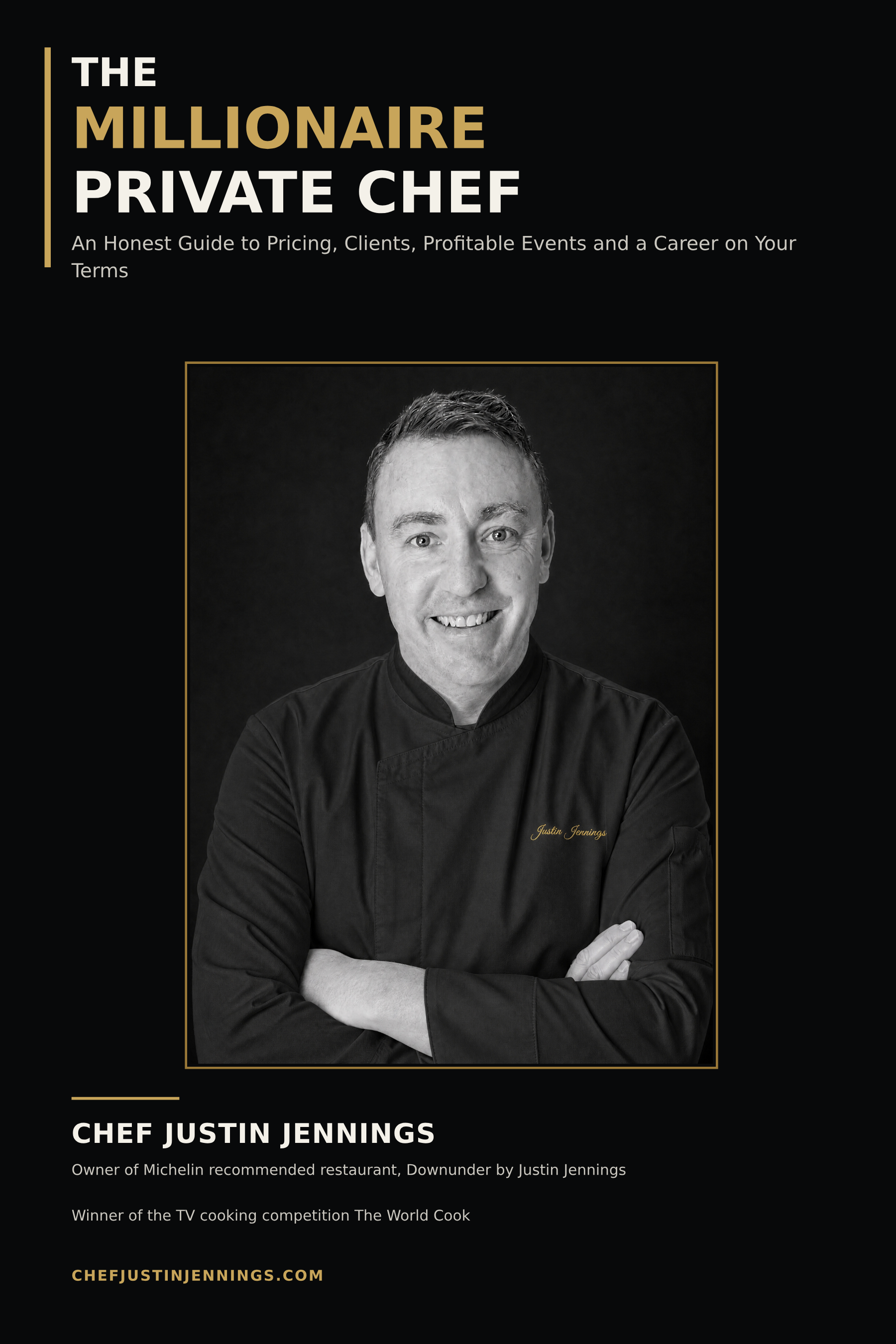
It's Tuesday night, 10:47pm. You've just finished a 12-hour shift. Your feet hurt, your back aches, and you have to be back in 11 hours for the lunch prep. You're scrolling Instagram in bed, seeing other private chefs posting photos of their €1,200 Saturday night events, working from beautiful client homes, controlling their own schedules.
And you think: "I want that. But I can't afford to quit my restaurant job yet."
I know exactly how that feels. In 2017, I was working 50-55 hour weeks as a sous chef in Lisbon making €3,200 a month. I wanted to start my private chef business, but I had rent to pay, bills due, zero savings. Quitting wasn't an option.
So I built my private chef business at night and on weekends while keeping my restaurant job. It took 7 months. It was exhausting. But it worked. By the time I quit, I had €8,000 in savings, 3-4 consistent monthly clients, and the foundation of what would become a €7,000/month business within a year.
This is the exact strategy I used - the timeline, the tactics, what worked, what didn't, and how you can do the same thing without burning out or getting fired.
The Reality Check: What "Part-Time" Actually Means
Let's be honest about what you're signing up for. Building a private chef business while working full-time is not easy. It's a temporary grind with a clear payoff, but you need to understand the cost before you start.
You will be tired. Working 50 hours at your restaurant job plus 10-15 hours on your side business means 60-65 hour weeks for several months. Your social life will suffer. You'll miss events. Sleep will be precious.
You will have limited availability. Most private chef events happen Friday and Saturday nights - the same nights you're working in restaurants. You'll be competing for bookings with full-time private chefs who can offer clients any day of the week.
You will have to say "no" to money. Clients will want you on nights you're working. You'll see opportunities you can't take. This is part of the process - don't quit your job prematurely trying to catch every booking.
The upside? You'll have consistent income while building your business. You'll test the market without risking everything. You'll learn what works before going all-in. And when you finally quit, you'll have savings, clients, and confidence.
I was exhausted for 7 months. But it was worth it because I left my restaurant job with a functioning business, not just a dream.
Month 1-2: The Setup Phase (0 Events, All Groundwork)
Don't chase clients yet. Use your first 6-8 weeks to build the foundation. This is the boring work that most chefs skip - and why they struggle later.
Legal & Admin (Week 1-2):
- Register your business. Sole trader is simplest. I registered online in Portugal in 45 minutes for €0. Check requirements in your country.
- Get liability insurance. Non-negotiable. I pay €680/year for €2M coverage. Clients often ask for proof.
- Open a separate bank account. Never mix personal and business money. Makes taxes infinitely easier.
- Check your employment contract. Look for non-compete clauses or exclusivity terms. Most restaurant contracts don't prohibit side work, but verify.
Brand & Presence (Week 2-4):
- Simple website. One page is fine. About you, services, pricing, contact form, portfolio photos (use restaurant food for now). I used Squarespace - took 4 hours, €12/month.
- Business Instagram. Post 3x per week minimum. Behind-the-scenes restaurant shots (if allowed), plating, ingredients. Tag location. Use hashtags: #privatechef + #yourcity.
- Professional photos. Borrow a photographer friend or hire one for €150. Get 10-15 quality shots of you cooking + plated dishes. Essential for credibility.
- Google Business Profile. Free listing. Shows up in local searches. Add photos, services, service area.
Pricing & Services (Week 4-6):
- Define your offerings. Start narrow: 4-6 course tasting menus for 4-10 guests. Don't offer everything - specialize.
- Set your rates. Minimum €75-85/person for your city (research local competition). Don't underprice out of fear - you'll regret it.
- Create 3 sample menus. Show your style. List dietary accommodations. Make it easy for clients to visualize.
- Standard terms. Deposit policy (I require 30%), cancellation terms, what's included/not included. Protect yourself from the start.
I spent €1,200 total on setup: insurance (€680), website (€12/month), photographer (€150), business cards (€40), basic mobile equipment (€300). That's it. Don't spend more until you have bookings.
💡 Pro Tip: Do all this setup work on your days off and after shifts. Use lunch breaks to research. Wake up 30 minutes early to post on Instagram. Treat it like a part-time job because it is one.
Month 3-4: Landing Your First Clients (2-4 Events)
Now you're ready to find clients. Start with your existing network - it's the fastest path to your first bookings.
Method 1: Tell everyone you know.
I posted on my personal Facebook/Instagram: "I'm starting a private chef business for special dinners and events. If you or anyone you know is looking, here's what I offer." Included sample menu and pricing.
Result: My first client was a friend's coworker. €700 for 8 guests. Booked within 5 days of posting.
Method 2: Leverage restaurant connections.
Tell regular customers (discreetly). Mention it to supplier reps who interact with high-end clients. Ask front-of-house staff if they know anyone planning events. Word-of-mouth from trusted sources converts better than ads.
My second client came from a wine supplier who mentioned me to a client hosting a birthday dinner. €950 for 10 guests.
Method 3: Partner with complementary businesses.
Reach out to wedding planners, event coordinators, villa rental managers, yacht charter companies. Offer them 10-15% referral commission for bookings. They have clients who need chefs.
I partnered with 3 wedding planners in month 3. Got my first wedding gig (€2,400) in month 5 through one of them.
Method 4: Local food/expat Facebook groups.
Join groups for your city's expat community, foodie scene, event planning. Participate genuinely for 2-3 weeks, then post a soft introduction: "Hey everyone, I'm a chef starting private dinner services. Happy to answer any questions about menus or catering for small events."
This got me consistent inquiries. Converted about 20% to bookings.
Important: Schedule strategically.
Only accept events on your day off or after short shifts (if you have any). I worked Tuesday-Saturday at my restaurant, so I booked private events on Sundays and occasional Monday evenings. Yes, it meant working 7 days some weeks. But only for a few months.
Month 5-7: Building Momentum (1-2 Events Per Week)
By month 5, I was averaging 1-2 private events per week on top of my restaurant job. This is when things start compounding - every event leads to referrals, reviews, and portfolio content.
Systematize everything:
- Client inquiry template. Copy-paste response with availability, pricing, sample menus, and next steps. Don't rewrite every email.
- Prep system. Menu planning on Monday morning (30 min), grocery shopping on your day off (2 hours), prep before the event (timeline per dish).
- Equipment checklist. I packed my kit the night before every event: knives, thermometer, portable burner, serving plates, linens. Never scramble day-of.
- Post-event routine. Thank you email within 24 hours, ask for Google review, request permission to use photos, note what went well/wrong.
Document everything for marketing:
Every event is content. I took 5-10 photos per event (setup, plating, happy clients) and posted 1-2 to Instagram within 48 hours. Tagged location. Told a story in captions. This attracted new inquiries weekly.
Track your finances obsessively:
I kept a simple spreadsheet: Date, Client, Gross Revenue, Food Cost, Net Profit. By month 7, I knew exactly how much I was making per event (avg €450 net on €950 bookings) and how much I'd saved (€8,200).
This tracking gave me the confidence to quit. I could see the numbers proving it was viable.
Ready to make the full transition? My book includes the complete timeline, client acquisition strategies, pricing calculator, and templates I used to build my business while working full-time.
Buy on AmazonWhen to Quit Your Restaurant Job (The Math)
Don't quit too early. Don't quit too late. Here's the formula I used:
You're ready to quit when you have:
- 3-6 months of living expenses saved. I had €8,200 saved from side events over 7 months. My monthly expenses were €1,400, so that was ~6 months of runway.
- Consistent monthly bookings. I was averaging 6-8 events per month (1.5-2 per week), generating €2,800-3,600/month net profit. Not quite replacement income yet, but close and trending up.
- A pipeline of inquiries. I had 4-5 new inquiries per week via Instagram, website, and referrals. Conversion rate was about 30%, meaning 1-2 new bookings weekly.
- Mental readiness. I wasn't scared of the uncertainty anymore. I had proof the business worked. I was more excited than anxious.
I quit in month 7. Gave 4 weeks notice (professional, left on good terms). By month 9, I was making more as a private chef than I ever did in restaurants.
Signs you should wait a bit longer:
- Less than 3 months of savings
- Fewer than 3-4 bookings per month
- No marketing system (you're relying purely on word-of-mouth)
- You're terrified and have no plan B
Slow and steady wins. I've seen chefs quit too early (month 2-3) with no savings and fail because they couldn't survive the slow months. I've also seen chefs stay in restaurants for 2+ years when they were ready to leave at month 8, just out of fear.
Trust the numbers. When the math says you're ready, make the leap.
Common Mistakes (And How to Avoid Them)
Mistake 1: Underpricing because you're "just starting out."
I charged €75/person for my first 3 events because I was nervous. Then I raised it to €85, then €95. Clients didn't care - they hired me for quality, not cheapness. Charge what you're worth from day one. You can't unprice yourself later without awkwardness.
Mistake 2: Saying yes to every inquiry.
I took a €50/person event in month 2 because I was desperate for bookings. Terrible client, low pay, exhausting experience. I should have said no. Protect your time and energy - bad clients drain both.
Mistake 3: Using your restaurant's kitchen/equipment without permission.
Never. Ever. Do this. Liability nightmare. You'll get fired if caught. Cook at client homes or rent commercial kitchen space by the hour (€15-30/hour in most cities).
Mistake 4: Burning out before you quit.
I hit a wall in month 6. Working 7 days per week, barely sleeping, irritable, making mistakes at work. I scaled back to 1 event per week for 2 weeks, slept properly, recovered. Then resumed. Don't sacrifice your health - the business won't matter if you break down.
Mistake 5: Not documenting your events.
Early on, I forgot to take photos at several events. Huge regret - I had no content to show new clients. Always take photos (ask permission first). Every event is portfolio material.
The 7-Month Timeline (Summary)
Here's the condensed version of exactly what I did:
- Month 1-2: Legal setup, insurance, website, Instagram, pricing, sample menus. 0 events, all groundwork. Cost: €1,200.
- Month 3: First client via friend referral (€700). Second via supplier connection (€950). Started telling everyone I knew.
- Month 4: 3 events (€2,400 total). Partnered with wedding planners. Posted event photos weekly on Instagram.
- Month 5: 5 events (€4,200 total). First repeat client. Started getting inquiries from Instagram. Exhausted but encouraged.
- Month 6: 7 events (€5,800 total). Hit a burnout wall mid-month, scaled back temporarily. Crossed €5,000 in savings.
- Month 7: 6 events (€5,200 total). Consistent pipeline of inquiries. Savings: €8,200. Gave notice at restaurant. Last shift was 3 weeks later.
Total side income over 7 months: €19,250 gross, €11,400 net (after food costs), €8,200 saved (after taxes and personal expenses).
By month 9 (2 months after quitting), I was making €7,000/month working 30-35 hour weeks with full control of my schedule.
The Hard Truth: Is It Worth It?
Building a private chef business while working full-time in a restaurant is one of the hardest things I've done. For 7 months, I was exhausted, stressed, and stretched thin.
But it was 100% worth it because when I finally quit my restaurant job, I wasn't jumping into the unknown. I was stepping into a functioning business with clients, systems, savings, and confidence.
Most chefs I know who tried to go straight from restaurant to full-time private chef without a transition period either:
- Ran out of money in months 2-3 and had to go back to restaurants
- Panicked and took terrible clients out of desperation
- Gave up entirely because the slow start was too stressful
The part-time transition isn't glamorous. But it works. It's the safe path to freedom.
If you're working in a restaurant right now, dreaming of private chef life, start tonight. Register your business. Set up Instagram. Tell one person. Take the first small step.
In 7-9 months, you could be exactly where I am.
Frequently Asked Questions
Can you start a private chef business while working full-time?
Yes. I built my private chef business over 7 months while working 50-hour weeks as a sous chef. Start with weekend events only, use your day off for admin and marketing, and save money from side gigs to build a financial cushion. Most successful private chefs I know transitioned gradually rather than quitting cold turkey.
How many hours per week do you need to start a side private chef business?
Realistically, 10-15 hours per week minimum: 2-3 hours for marketing and admin during the week, one full day off (8-12 hours) for events. You'll be exhausted, but it's doable for 3-6 months until you have consistent bookings and savings to quit your restaurant job.
Do you need your employer's permission to do private chef events?
Check your employment contract for non-compete or exclusivity clauses. Most restaurant contracts don't prohibit side work, but some high-end establishments do. If there's no clause, you don't need permission - but be discreet and never poach restaurant clients or suppliers. I kept my side business quiet until I was ready to leave.
How long does it take to transition from restaurant chef to full-time private chef?
Typically 4-9 months. Expect 2-3 months to land your first few clients, another 3-6 months to build consistent bookings (2-3 events per week), and enough savings to cover 3-6 months of expenses. I took 7 months total - slower is safer than jumping too early and failing.
What's the best way to find private chef clients while working full-time?
Leverage your existing network first: tell friends, family, and regular restaurant customers about your side business. Use your one day off to attend food events and network. Build a simple website and Instagram presence. Partner with wedding planners and villa rental managers. Word-of-mouth is your most powerful tool early on.
How much money should you save before quitting your restaurant job?
Minimum 3 months of living expenses, ideally 6 months. I saved €8,000 over 7 months (about €1,150/month from side events) before quitting. This covered rent, bills, insurance, and startup costs while I scaled my bookings. Don't quit until you have both savings AND consistent monthly bookings.
Can you use your restaurant kitchen for private chef events?
No - unless you have explicit written permission and insurance coverage. Most restaurant kitchens are off-limits for outside work due to liability and health code issues. Cook at clients' homes or rent commercial kitchen space by the hour. Never risk your restaurant job by using their equipment without permission.
Should you tell your restaurant employer about your private chef side business?
Only if required by contract or if you have a supportive relationship. Many restaurant owners view side businesses as disloyalty or distraction, even if it's not prohibited. I kept mine quiet and gave 4 weeks notice when ready to leave full-time. Be professional, don't poach their clients, and leave on good terms.
What equipment do you need to start a part-time private chef business?
Start minimal: 1-2 good chef knives, knife roll, meat thermometer, peeler, microplane, and portable induction burner. Most clients have basic cookware. I spent €300 initially and gradually added equipment as bookings increased. Don't blow savings on a full mobile kitchen setup before you have consistent clients.
How do you balance restaurant shifts and private chef bookings without burning out?
Accept maximum 1-2 events per week on your day off or after short shifts. Block sleep time (7 hours minimum) and say no to bookings that conflict. Meal prep your own food to save time. Expect to be tired for 3-6 months - it's temporary. I treated it like a second job because it was my path to freedom.
Ready to Make the Transition?
My book includes the complete 7-month timeline, client acquisition templates, pricing calculator, legal checklist, and marketing strategies I used to build my private chef business while working full-time.
Buy on AmazonPaperback, 120 pages. Available on Amazon.