Pricing Strategy
Private Chef Pricing Guide: What to Charge in 2026 (With Real Examples)
26 May 2026 · 14 min read
Get my complete pricing calculator, cost breakdown templates, and word-for-word scripts for discussing pricing with confidence.
Buy on Amazon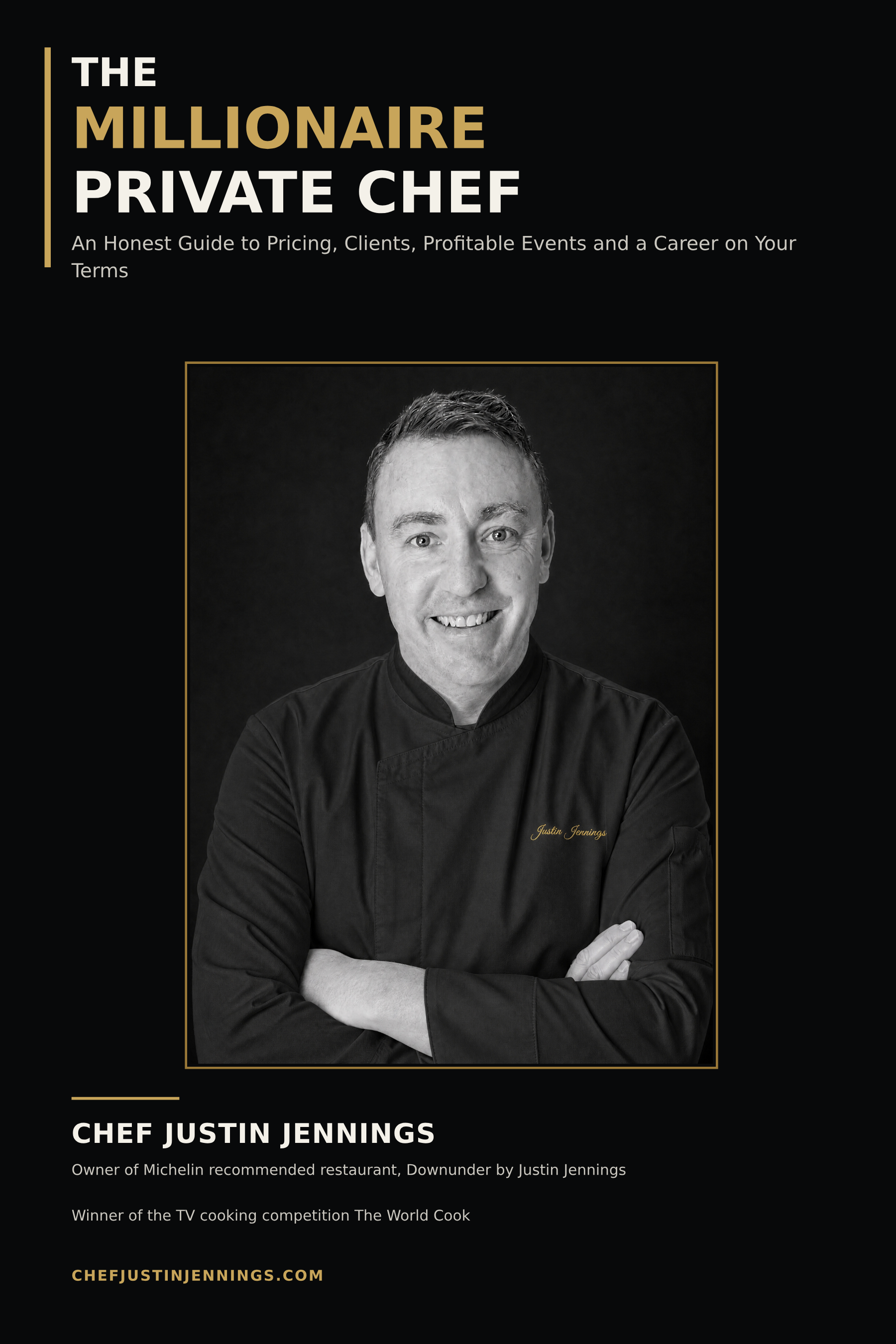
Pricing is where most private chefs fail. They undercharge, burn out, and quit within a year. I've watched it happen repeatedly talented chefs who could have built great businesses, gone because they couldn't figure out what to charge.
When I started, I charged €65 per person. I thought I was being competitive. What I actually was being was cheap and clients could smell it. I attracted price-shoppers who negotiated every detail and rarely rebooked. I worked harder than ever and earned less than my restaurant salary.
Then I raised my prices to €95 per person. Something surprising happened: I got more inquiries, not fewer. Clients perceived higher value. They respected my time. They tipped better. And I cleared €800-€1,200 per event instead of €500-€600.
This guide is everything I've learned about pricing private chef services. Real numbers. Real examples. The mistakes I made so you don't have to.
Pricing Psychology: Why €95 Beats €85
Before we get to numbers, understand this: pricing is psychological. Clients don't evaluate your price in a vacuum they evaluate it against perceived value.
The anchoring effect: When you quote €85/person, clients think "budget option." When you quote €105/person, they think "premium experience." The difference in actual work? Maybe 10%. The difference in perceived value? Massive.
Price-quality heuristic: Humans assume expensive = better. It's not rational, but it's real. A client choosing between a €75/person chef and a €105/person chef often assumes the more expensive one is more skilled even if the food is identical.
Your comfort level matters: If you quote €75 and feel undervalued, that resentment shows. You're less enthusiastic, less generous with extras, less likely to go above and beyond. When you quote €105 and feel fairly compensated, you bring your best energy. Clients notice.
The threshold effect: Most private chefs cluster around €75-€85. When you price at €95-€105, you separate yourself from the commodity market. You're no longer competing on price you're competing on experience, quality, and reliability.
My Pricing Tiers: What I Actually Charge
Here are my current pricing tiers for 2026. These are real numbers I use with clients:
Entry Tier: €85 Per Person
Best for: Casual gatherings, BBQs, family-style service, repeat clients
- 3-4 courses or substantial family-style meal
- Quality ingredients but no luxury items (wagyu, truffle, caviar)
- Standard presentation
- Service for up to 12 guests
- Includes shopping, prep, cooking, service, cleanup
- 2-3 hours of event time
My food cost: ~25% (€21/person). My time: ~5 hours total. Effective hourly rate: €102/hour.
Standard Tier: €105 Per Person ★ Most Popular
Best for: Dinner parties, celebrations, corporate events
- 4-5 courses with bread and amuse-bouche
- Premium ingredients (seafood, quality meats)
- Plated service with garnishes
- Service for 6-16 guests
- Printed menus and tableside descriptions
- 3-4 hours of event time
My food cost: ~28% (€29/person). My time: ~6 hours total. Effective hourly rate: €101/hour. This is my sweet spot most bookings land here.
Premium Tier: €130 Per Person
Best for: Special occasions, VIP clients, wine pairing dinners
- 6-7 course tasting menu
- Luxury ingredients (wagyu, truffle, caviar, lobster)
- Artistic plating and presentation
- Service for 4-12 guests (intimate focus)
- Custom menu development
- Coordination with sommelier for wine pairings
- 4-5 hours of event time
My food cost: ~32% (€42/person). My time: ~7 hours total. Effective hourly rate: €100/hour. Higher food costs, but higher perceived value attracts discerning clients.
Luxury Tier: €180+ Per Person
Best for: Ultra-high-net-worth clients, yacht charters, destination events
- Fully customized multi-course experience
- Rare and imported ingredients
- Multiple service staff (I bring assistant)
- Tableside cooking and interactive elements
- Pre-event tastings and consultations
- Unlimited menu revisions
- Full day dedicated to event
Food cost: 35-40%. These events require 8-12 hours of work but clear €1,500-€3,000+ total.
Get my complete pricing calculator
The book includes a spreadsheet that calculates your exact rates based on food costs, time, and desired profit margin plus scripts for every pricing conversation.
What's Included (And What Clients Don't See)
Clients pay one number: €105 per person. But that number represents hours of invisible work. Understanding this helps you price with confidence and explain your value when asked.
Pre-event (3-4 hours):
- Menu consultation and planning (30-60 min)
- Grocery shopping at 2-3 suppliers (90-120 min)
- Travel to/from markets (30-60 min)
- Prep work at home (if permitted): stocks, sauces, desserts (60-90 min)
- Packing equipment and ingredients (30 min)
Event day (5-7 hours):
- Travel to venue (30-60 min)
- Setup and kitchen organization (30 min)
- Final prep and cooking (2-3 hours)
- Service (2-3 hours depending on courses)
- Cleanup and kitchen restoration (45-60 min)
- Travel home (30-60 min)
Total time per event: 10-12 hours. At €105/person for 8 guests (€840 total), that's €70-84/hour effective rate not the €140/hour clients sometimes think.
Hidden costs clients don't see:
- Vehicle expenses (fuel, parking, wear): €20-€50/event
- Equipment depreciation and replacement: €10-€20/event
- Insurance (spread across events): €15-€25/event
- Website, marketing, admin time: €20-€30/event
- Taxes (set aside 25-30%): €210-€250 per €840 event
Your real profit on that €840 event? Around €400-€450 after all costs and taxes. Still excellent money but knowing the math helps you stand firm on pricing.
Pricing Mistakes I Made (So You Don't)
Mistake #1: Undercharging to "get started" (Year 1)
I charged €65-€75/person for my first 15 events, thinking I needed to prove myself. Wrong. I proved I was cheap. When I raised to €95, my booking rate stayed the same but my income jumped 40%.
Lesson: Price for where you're going, not where you are. You're a professional chef you're not "learning" at the client's expense.
Mistake #2: Not accounting for travel (Event #8)
I booked a dinner 90 minutes away at my normal rate. After fuel, tolls, and 3 hours of driving, I earned less than minimum wage. Now I add €50 travel fee for locations over 45 minutes away.
Lesson: Map your service area and charge for distance. Your time in transit is time you can't cook for other clients.
Mistake #3: Discounting for "simple" menus (Year 2)
A client wanted "just a BBQ" and I quoted €75 instead of €95. The work was identical shopping, setup, cooking, cleanup. The "simple" menu actually required more equipment (portable grill, charcoal). I lost money.
Lesson: Your minimum is your minimum. A BBQ isn't easier than a plated dinner it's different. Price reflects your time and expertise, not just ingredients.
Mistake #4: Not raising prices as I improved (Year 2-3)
I kept the same rates for 18 months despite gaining experience, testimonials, and media coverage. I left €15,000+ on the table. Now I review pricing every 6 months and raise 10-15% if I'm consistently booked.
Lesson: You're not the same chef you were 6 months ago. Raise prices as you grow.
Mistake #5: Quoting without deposits (Early bookings)
I used to hold dates based on verbal commitments. Cancellations cost me thousands. Now I require 50% deposit to confirm, non-refundable within 7 days of event.
Lesson: Your time has value. Deposits filter serious clients and protect your income.
Scripts: How to Talk About Pricing Without Awkwardness
The biggest fear new private chefs have: "What if they say it's too expensive?" Here's the truth: if no one ever says you're too expensive, you're definitely too cheap. A healthy business loses 20-30% of inquiries on price.
Script 1: The Initial Quote
"For a dinner party of 8 guests with a 4-course menu, my rate is €105 per person, totaling €840. This includes all groceries, preparation, cooking, service, and complete cleanup. I'll bring everything needed ingredients, equipment, even serving platters. You just provide the kitchen and guests. Would you like to see some sample menus at this level?"
Why it works: States price clearly without apologizing. Immediately follows with what's included to justify value. Ends with a question to move conversation forward.
Script 2: When They Say "That's More Than I Expected"
"I understand private chef pricing can be surprising if you haven't hired one before. To put it in perspective, a comparable meal at a MICHELIN-recognized restaurant would be €120-€150 per person before wine, plus you'd be in a dining room full of strangers instead of your own home. You're getting restaurant-quality food with complete privacy and personalized service. That said, I can adjust the menu to fit a lower budget if you'd like perhaps a family-style service instead of plated courses?"
Why it works: Validates their reaction without agreeing. Reframes value with comparison. Offers alternative instead of discount.
Script 3: When They Ask for a Discount
"I don't offer discounts on my standard rates every client receives the same high level of service and quality ingredients. However, if budget is a concern, I have a few options: we could adjust the menu to use more seasonal ingredients, do a family-style service which requires less plating time, or schedule on a weekday when I have more flexibility. Would any of those work for you?"
Why it works: Politely but firmly declines discount. Offers value-preserving alternatives. Maintains positioning.
Script 4: The Follow-Up After Quote
"Hi [Name], following up on the menu we discussed. I wanted to mention that my calendar is filling up for [month] I only take 6-8 events per month to ensure each client gets my full attention. If you'd like to secure your date, I just need a 50% deposit. Happy to answer any questions about the menu or pricing!"
Why it works: Creates gentle urgency without pressure. Reminds them of value (limited availability). Clear next step.
When to Charge More (And How Much More)
Standard rates are just the starting point. These situations justify premium pricing:
Holiday events: Christmas Eve, New Year's Eve, Valentine's Day add 25-50% (€130-€155/person). High demand, personal sacrifice.
Last-minute bookings: Within 2 weeks of event add 20% (€125/person). Disrupts your schedule, requires rush shopping.
Complex dietary restrictions: Multiple allergies, vegan/gluten-free/kosher combined add 15-20% (€120-€125/person). Requires extra research, specialty ingredients, cross-contamination protocols.
Travel to destination: Overnight stays, yacht charters, villa bookings charge daily rate (€800-€1,500/day) plus expenses. You're on-call 24 hours.
Additional services: Wine pairing consultation (+€100), floral/decor coordination (+€150), additional staff (+€200/server). These are profit centers mark up 30-50% above your cost.
Corporate clients: Companies have bigger budgets and expense accounts. Corporate events can support €120-€150/person for the same menu you'd charge €105 for private clients.
Geographic Pricing: What Chefs Charge Worldwide
Your location affects pricing dramatically. Here's what experienced private chefs charge in different markets:
| Market | Entry | Standard | Premium |
|---|---|---|---|
| London | £75-85 | £95-120 | £140-200 |
| Paris | €80-90 | €100-125 | €150-220 |
| Lisbon/Portugal | €70-80 | €85-105 | €120-160 |
| Dubai | €100-120 | €140-180 | €220-350 |
| New York | $95-115 | $130-160 | $200-300 |
| Los Angeles | $85-105 | $120-150 | $180-250 |
| Sydney | A$100-120 | A$140-170 | A$200-280 |
Cost of living matters but not as much as you think. A chef in Lisbon charging €105/person can earn an excellent living because costs are lower. A chef in London charging £120/person has higher expenses. Focus on your local market rate and your personal financial goals, not just what chefs elsewhere charge.