Real Talk
What to Expect Your First Year as a Private Chef (The Truth)
May 2026 · 11 min read
Thinking about making the jump? My book covers exactly what to expect month-by-month in your first year, including the mistakes I made so you don't have to.
Buy on Amazon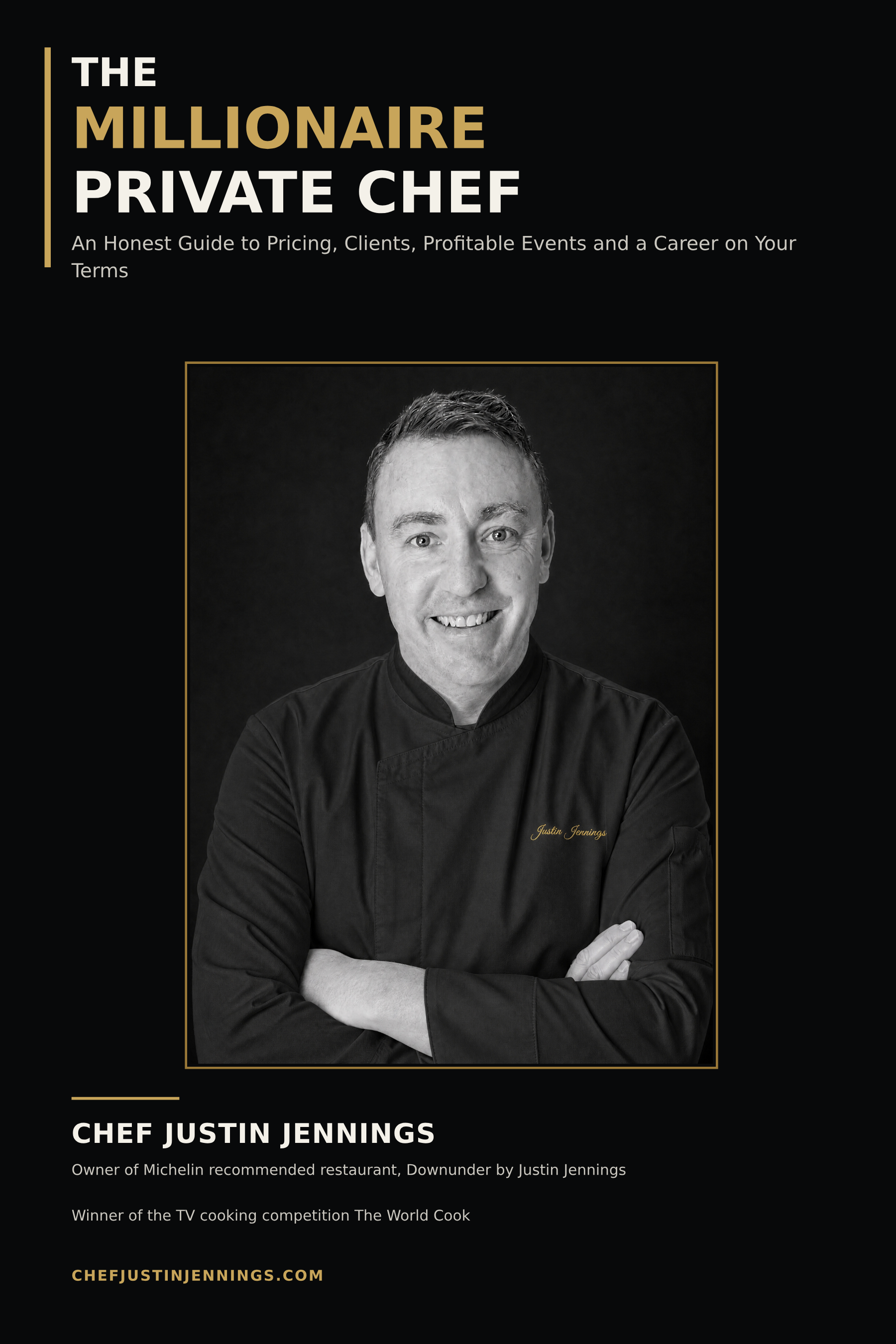
Nobody tells you how brutal the first year is. Not brutal like restaurant hours brutal - different brutal. The kind where you're making great money one week and questioning your entire life the next. Where you nail a ten-person tasting menu on Saturday and have zero bookings the following week.
I've been a private chef for eight years. I love it. But year one nearly broke me, and I had culinary experience, business sense, and a decent network. If you're making this transition, you need to know what's actually coming.
This isn't a pep talk. This is the truth about your first year as a private chef - the slow starts, the pricing mistakes, the imposter syndrome, and how to survive it all.
Months 1-3: The Excitement Phase (and the Reality Check)
You'll start with momentum. Maybe you've been planning this for months. You've got a logo, a website, an Instagram account. You're ready. You tell everyone you know that you're a private chef now. You post your services. You wait for bookings to flood in.
They don't.
The first three months are about adjusting expectations. You'll probably book 2-5 events total, mostly through friends, family, or former colleagues. That's normal. You're unknown. You have no reviews, no social proof, no portfolio of drool-worthy food photos.
What I did wrong: I charged €60 per person because I thought I had to compete on price. Wrong. Clients don't hire private chefs because they're cheap - they hire us because we're good. Undercharging made me look inexperienced (which I was) and attracted clients who treated me like hired help instead of a professional.
What you should do instead: Start at €75-85 per person minimum. Charge enough to respect yourself and your work. If you're too cheap, you'll resent the job before you even get started. Better to book fewer events at proper rates than lots of events that barely cover costs.
Months 4-6: The Grinding Phase
This is where most people quit. You're past the initial excitement. The novelty wore off. You've done maybe 10-15 events. Some went great. Some were disasters. You're still working your restaurant job or freelancing on the side because the private chef income isn't reliable yet.
You're exhausted. Not physically (you're working way less than restaurant hours) but mentally. The uncertainty is draining. One week you're booked solid. The next week nothing. You don't know if this is working.
What actually happens: This is the filter phase. The chefs who survive months 4-6 are the ones who commit to systems. You need a process for following up with inquiries. You need a standard menu. You need a grocery shopping list template. You need contracts.
I didn't figure this out until month seven. I was winging every event - custom menus, last-minute shopping trips, forgetting critical ingredients. It worked, barely, but it wasn't scalable. Once I built systems (standard 3-course, 5-course, and 7-course menus I could customize), my stress dropped by half.
Skip the trial and error
My book includes menu templates, pricing calculators, contract templates, and step-by-step systems for your first 100 events.
Months 7-9: The Breakthrough
Somewhere around month six or seven, something shifts. You start getting referrals. A client books you twice. Someone finds you on Google. Your Instagram starts working. Bookings still aren't consistent, but they're more frequent.
You'll have your first €1,000+ week. Maybe it's two events, maybe three. You'll do the math and realize: if I can make €1,000 in one week working 20 hours, this might actually work.
This is when imposter syndrome hits hardest. You'll walk into someone's €2 million villa and think "who the hell am I to be here?" You'll cook for a CEO or a celebrity and wonder if they're secretly disappointed. You'll plate a dish and think it looks amateur.
The truth: Everyone feels this. Every private chef I know went through it. The clients hired you. They're paying you. They want you to succeed. Stop sabotaging yourself.
By month nine, you'll have 25-35 events under your belt. You'll have repeat clients. You'll have systems. You'll know your pricing. You'll start to feel like this is real.
Months 10-12: Deciding If This Is Your Future
The final quarter of year one is decision time. You've been doing this long enough to know if it's working. You have data. You know your monthly average. You know your expenses. You know if you can make this full-time or if it's a side hustle.
For me, month ten was when I realized I was booking 3-4 events per week consistently. I was clearing €2,500-3,000 per month working 25-30 hours. Not amazing, but better than my sous chef salary for half the hours. By month twelve, I was at €3,500 per month and had a waitlist for weekends.
That's when I quit the restaurant. Best decision I ever made.
But here's the thing - not everyone hits those numbers in year one. Some chefs stay at 1-2 events per week. That's fine. That's still €1,200-1,600 per month for 10-12 hours of work. It can be a great side income while you build.
The question you need to answer by month twelve: Do I want to scale this or keep it small? Both are valid. I know private chefs who do 2-3 events per month and make €25K per year on the side. I know others who do 15-20 events per month and clear €100K+. Neither is better. It depends what you want.
The Mistakes Everyone Makes (And How to Avoid Them)
1. Underpricing your services
I've said it already but it bears repeating: don't charge €50-60 per person to "get clients." You'll attract nightmare clients, burn out fast, and never make enough to justify the work. Start at €75-85 minimum. Increase to €95-105 by month six. Charge €120+ by year two.
2. Saying yes to bad clients
You'll get inquiries from people who want a seven-course tasting menu for €40 per person. From people who want you to work for "exposure." From people who are rude in the initial email. Say no. A bad client will ruin your week, tank your confidence, and leave a shit review.
3. Overcomplicating menus
I tried to reinvent the wheel for every event in year one. Custom everything. Different cuisines. Experimental dishes. It was exhausting and inconsistent. Build 2-3 core menus you can execute perfectly. Customize from there.
4. Not having contracts
I lost €800 in month four because a client canceled 48 hours before the event and I had no cancellation policy. Get a contract template. Use it every time. Require 50% deposit upfront. Have a clear cancellation policy (I do 72 hours for full refund, 48-72 hours for 50% refund, under 48 hours no refund).
5. Ignoring the business side
You're not just a chef anymore. You're a business. That means invoices, taxes, insurance, licenses. I didn't get proper business insurance until month eight. Stupid. If I'd injured a client or burned down their kitchen, I'd have been finished. Get liability insurance before your first paid event. It's €300-600 per year. Non-negotiable.
The Metrics That Actually Matter in Year One
Forget revenue. Forget Instagram followers. Here's what you should track:
Event count
Aim for 40-60 events in year one. That's roughly one per week. If you hit 60+, you're crushing it. Under 30 and you need to rethink your marketing.
Repeat client rate
By month twelve, 30-40% of your events should be repeat clients or referrals from past clients. If it's under 20%, your food or service needs work.
Average booking value
Calculate: total revenue divided by total events. If it's under €500, you're either underpricing or booking too many small events. Target €600-800 average by month twelve.
Inquiry-to-booking conversion rate
Track how many inquiries turn into bookings. Good rate: 40-50%. Under 30% means your pricing is too high, your response time is too slow, or your communication needs work.
Want the full first-year roadmap?
My book breaks down months 1-12 week by week, including exactly what to focus on and when.
What Nobody Tells You About the Mental Game
The hardest part of year one isn't the cooking. It's the psychology. You go from being an employee with a set schedule and guaranteed paycheck to being self-employed with variable income and complete autonomy.
Some weeks you'll make €1,500 and feel invincible. Other weeks you'll make €200 and panic. The highs are higher. The lows are lower. You need emotional resilience.
What helped me:
- Tracking my numbers religiously so I could see trends, not just weekly chaos
- Building a 3-month emergency fund before going full-time
- Connecting with other private chefs (we have a WhatsApp group - it's therapy)
- Reminding myself that slow weeks are normal, not failure
- Celebrating wins (first €1K week, first repeat client, first five-star review)
Year one is a mental endurance test. If you make it through, year two gets easier. By year three, you'll have consistent income, repeat clients, and systems that run themselves. But you have to survive year one first.
Should You Still Do This?
After reading all this, you might be thinking "fuck that, I'll stay in restaurants." Fair. But here's what I didn't mention:
Despite the uncertainty, the mistakes, and the self-doubt, year one as a private chef was still better than any year I spent in restaurants. I worked half the hours. I had weekends with my family. I didn't come home smelling like fryer oil. I made more per hour. I cooked food I was proud of.
Was it hard? Yes. Was it worth it? Absolutely.
The chefs who make it through year one share a few traits: they're resilient, they're willing to learn fast, they don't take rejection personally, and they treat this like a business, not a hobby.
If that's you, then yes - do this. Just go in with your eyes open. The first year isn't glamorous. It's messy. But if you survive it, you'll build a career that gives you freedom, income, and creative control that restaurants will never offer.
Final Thoughts
I'm not going to sugarcoat it: most people who try to become private chefs quit within six months. The income inconsistency scares them off. The lack of structure. The slow start. They go back to restaurants or leave the industry entirely.
But the ones who stick it out? We're living better lives. Working fewer hours. Making more money. Controlling our schedules. Cooking without ego-driven head chefs breathing down our necks.
Year one is the filter. If you make it through, you'll have a foundation to build on. And by year three or four, you'll wonder why you didn't do this sooner.
Just know what you're signing up for. Prepare for the slow start. Build systems early. Don't underprice. Get insurance. Track your metrics. And when the self-doubt hits (it will), remind yourself that every successful private chef went through the exact same shit.
You've got this. Just survive year one.
Ready to Start Your Private Chef Journey?
My book covers the complete roadmap: finding clients, pricing your services, building systems, scaling to full-time income, and avoiding the mistakes that sink most new private chefs in their first year.
Buy on Amazon